If you are gearing up for a technical screening this year, you already know the competition is fierce. Nailing your Python data science interview questions is the absolute baseline for landing a high-paying role or securing a lucrative remote global position from hubs like Kenya.
In 2026, tech companies are no longer just asking basic syntax questions. Interviewers want to see that you understand memory optimization, vectorized operations, modern library updates (like Pandas’ PyArrow backend), and how to deploy machine learning models efficiently.
Whether you are preparing for a rigorous live-coding session or a take-home assignment, this guide is your ultimate weapon. We have compiled the top 50 Python for data science technical interview questions, categorized by topic, complete with the detailed, fluff-free answers hiring managers actually want to hear.
Let’s dive in.
Table of Contents
How to Pass a Python Data Science Interview
- Master Core Python: Be prepared to explain lists, tuples, dictionaries, decorators, and list comprehensions.
- Optimize Pandas: Understand vectorization, apply(), .loc, and handling massive datasets efficiently.
- Know Scikit-Learn Pipelines: Don’t just train models; know how to bundle preprocessing and modeling into a Pipeline to prevent data leakage.
- Understand Metrics: Know exactly when to use Precision vs. Recall or MSE vs. MAE.
- Learn Production Tools: Familiarize yourself with FastAPI, Docker, and Git, which are heavily tested in 2026.
Learn more: 10 Highest Demand IT Skills for Remote Jobs
Python Data Science Interview Questions
Master the top 50 Python data science interview questions for 2026. Get detailed answers on Pandas, Machine Learning, and Python to land your dream job!
Category 1: Python Basics & Data Structures
Before diving into dataframes, interviewers test your foundational Python knowledge to ensure you write clean, Pythonic code.
1. What is the difference between a list and a tuple in Python?
Lists are mutable (can be changed after creation) and consume more memory. Tuples are immutable, consume less memory, and are generally faster to iterate through. Tuples are often used as dictionary keys.
2. How do decorators work in Python?
A decorator is a function that takes another function as an argument and extends its behavior without explicitly modifying it. In data science, they are often used for logging execution time or caching API responses (@lru_cache).
3. Explain the difference between deep copy and shallow copy.
A shallow copy creates a new object but inserts references into it to the objects found in the original. A deep copy creates a new object and recursively adds copies of the objects found in the original, ensuring changes to the copy don’t affect the original data.
4. What are *args and **kwargs?
*args allows a function to accept any number of positional arguments (as a tuple). **kwargs allows a function to accept any number of keyword arguments (as a dictionary).
5. How does a generator differ from a normal function?
Generators use the yield keyword instead of return. They generate values one at a time and suspend their state, making them highly memory-efficient for processing massive datasets that don’t fit into RAM.
6. What is a lambda function?
An anonymous, single-line function defined by the lambda keyword. In data science, they are heavily used inside Pandas apply() functions for quick data transformations.
7. Explain list comprehensions and their advantage.
List comprehensions provide a concise way to create lists using a single line of code (e.g., [x**2 for x in range(10)]). They are computationally faster than traditional for loops because they are optimized in C.
8. How do you handle exceptions in Python?
Using try, except, else, and finally blocks. This is critical in data pipelines to catch errors (like missing files or API timeouts) without crashing the entire script.
9. What is PEP 8?
PEP 8 is the official style guide for Python code. Adhering to it ensures code readability and consistency across collaborative data science teams.
10. What is the Global Interpreter Lock (GIL)?
A mutex that protects access to Python objects, preventing multiple native threads from executing Python bytecodes at once. This is why multi-threading in Python isn’t great for CPU-bound tasks, pushing data scientists to use multiprocessing instead.
Category 2: Numpy and Pandas Interview Questions
This is the core of any Numpy and Pandas interview questions round. You must demonstrate that you can manipulate data quickly and efficiently.
11. What is the difference between a Pandas Series and a DataFrame?
A Series is a one-dimensional array capable of holding any data type. A DataFrame is a two-dimensional, size-mutable tabular data structure with labeled axes (rows and columns). A DataFrame is essentially a dictionary of Series.
12. Explain the difference between .loc and .iloc.
.loc is label-based, meaning you use row/column names to select data. .iloc is integer-position-based, meaning you use numerical indices (0, 1, 2) to slice data.
13. How do you handle missing values in a dataset?
Depending on the context, you can drop them using dropna(), or impute them using fillna() with the mean, median, mode, or a predictive machine learning algorithm.
14. What is vectorization in NumPy/Pandas?
Vectorization refers to performing operations on entire arrays at once rather than using Python for loops. It pushes the iteration down to optimized C code, making it exponentially faster.
15. Explain Pandas’ groupby() function.
It splits the data into groups based on some criteria, applies a function to each group independently (like sum or mean), and combines the results into a data structure.
16. What is NumPy broadcasting?
Broadcasting describes how NumPy treats arrays with different shapes during arithmetic operations. The smaller array is “broadcast” across the larger array so they have compatible shapes.
17. How do merge(), join(), and concat() differ?
concat() stacks DataFrames vertically or horizontally. merge() combines DataFrames based on common columns (like a SQL JOIN). join() combines them based on their index.
18. What is the advantage of the PyArrow backend in modern Pandas?
Introduced in Pandas 2.0 and standard in 2026, PyArrow handles strings and missing values much more efficiently than NumPy, drastically reducing memory usage and speeding up operations.
19. When should you use apply() vs. transform()?
apply() can return a scalar or a Series of a different length than the original group. transform() must return a data structure of the exact same length as the original group, often used for broadcasting values back to the original dataframe.
20. How do you find correlations between columns?
By using df.corr(). By default, it calculates the Pearson correlation coefficient, but it can be adjusted for Spearman or Kendall.
21. What is a pivot table in Pandas?
Similar to Excel, pd.pivot_table() reshapes data, summarizing it by aggregating values based on one or more keys.
22. How do you read a massive CSV file that doesn’t fit into memory?
By using the chunksize parameter in pd.read_csv(), which returns an iterator that reads the file in manageable chunks. Alternatively, by switching to Polars or using Dask.
23. What does pd.melt() do?
It unpivots a DataFrame from a wide format to a long format, which is often required before feeding data into visualization libraries like Seaborn.
24. How do you drop duplicate rows?
Using df.drop_duplicates(). You can specify the subset parameter to only consider specific columns when identifying duplicates.
25. Why might a data scientist choose Polars over Pandas in 2026?
Polars is written in Rust, uses lazy evaluation, and is highly multi-threaded, making it significantly faster and more memory-efficient than Pandas for extremely large datasets.
Category 3: Data Visualization
26. Matplotlib vs. Seaborn: When to use which?
Matplotlib is highly customizable and great for complex, low-level plotting. Seaborn is built on top of Matplotlib, provides beautiful default styles, and is better suited for statistical visualizations with less code.
27. What is a pairplot?
A Seaborn function (sns.pairplot()) that plots pairwise relationships across an entire dataframe, allowing you to instantly see correlations and distributions between numerical variables.
28. How do you handle overlapping data points in a scatter plot?
By reducing the alpha (opacity) of the points, or by using a hexbin plot or 2D density plot to show the concentration of points.
29. What is Plotly used for?
Plotly is used for creating highly interactive, web-browser-based graphs (zooming, hovering for data). It is heavily used when building dashboards or presenting findings to non-technical stakeholders.
30. How do you save a Matplotlib plot as an image?
Using plt.savefig(‘filename.png’). It must be called before plt.show(), otherwise, it will save a blank image.
Category 4: Machine Learning Python Coding Questions
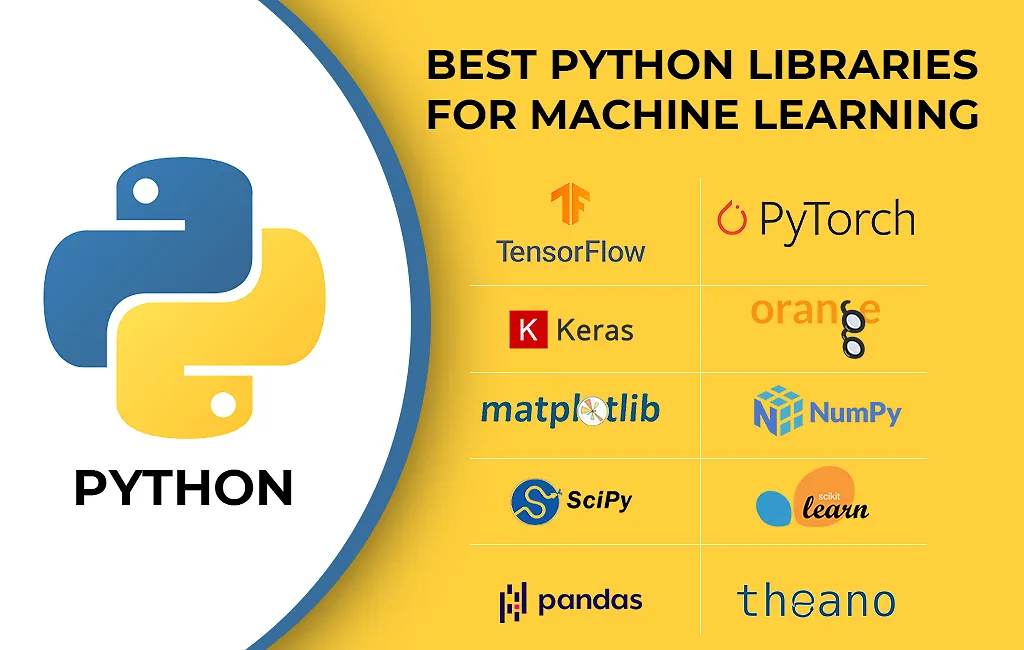
Your technical screen will heavily feature machine learning Python coding questions utilizing Scikit-Learn.
31. What does train_test_split do?
It randomly splits a dataset into training and testing subsets to ensure the machine learning model is evaluated on unseen data, preventing overfitting.
32. Explain the difference between StandardScaler and MinMaxScaler.
StandardScaler centers the data around a mean of 0 and a standard deviation of 1. MinMaxScaler scales the data to a fixed range, usually between 0 and 1.
33. How do you handle categorical variables in Scikit-Learn?
By using One-Hot Encoding (OneHotEncoder) for nominal data, or Label Encoding (LabelEncoder) for ordinal data.
34. What is the purpose of a Scikit-Learn Pipeline?
Pipelines chain together multiple data processing steps (like scaling and encoding) with an estimator (the ML model). This prevents data leakage and makes deploying the model to production much easier.
35. What is cross-validation?
A resampling procedure (like K-Fold) used to evaluate ML models on a limited data sample. It trains the model on different subsets of the data to ensure performance is consistent.
36. Random Forest vs. Decision Tree: What is the difference?
A Decision Tree is a single model that is highly prone to overfitting. A Random Forest is an ensemble method that creates multiple decision trees on random subsets of data and averages their predictions to improve accuracy.
37. How do you evaluate a classification model?
Using metrics like Accuracy, Precision, Recall, F1-Score, and the ROC-AUC curve. Precision is critical when false positives are costly; Recall is critical when false negatives are costly.
38. How do you evaluate a regression model?
Using metrics like Mean Absolute Error (MAE), Mean Squared Error (MSE), Root Mean Squared Error (RMSE), and R-squared.
39. What is PCA (Principal Component Analysis)?
A dimensionality reduction technique that transforms a large set of variables into a smaller one that still contains most of the original information, speeding up ML algorithms.
40. How do you tune hyperparameters in Scikit-Learn?
Using GridSearchCV (which tests all combinations exhaustively) or RandomizedSearchCV (which tests a random sample of combinations, which is faster).
Category 5: Advanced Python, LLMs, & Production
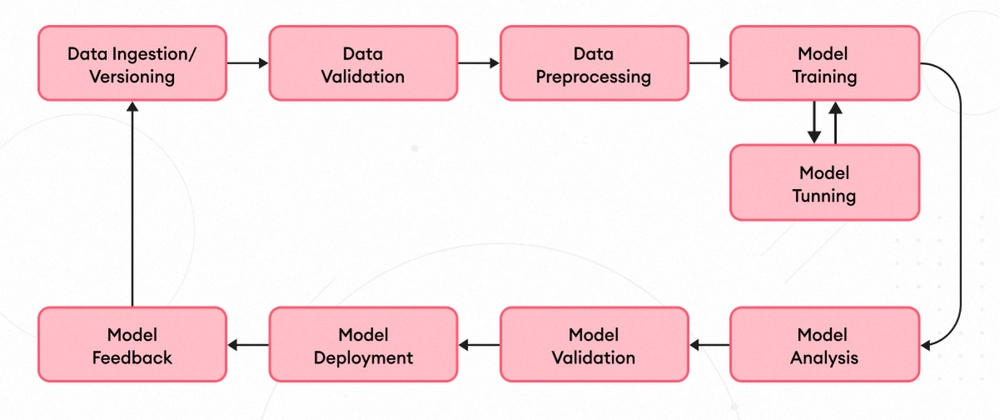
In 2026, data scientists must know how to put models into production and work with Generative AI APIs.
41. How do you save and load a trained machine learning model?
Using the joblib or pickle libraries to serialize the model object to a file, which can then be loaded into a production server.
42. What is FastAPI and why is it popular in data science?
FastAPI is a modern, high-performance web framework for building APIs. Data scientists use it to expose their machine learning models as API endpoints so web apps can send data and receive predictions.
43. How do you handle API rate limits when pulling data?
By implementing exponential backoff (using the time.sleep() function combined with try/except blocks) to pause the script if a 429 Too Many Requests error is returned.
44. What is a virtual environment and why use it?
Tools like venv or conda create isolated Python environments. This ensures that library dependencies for one project don’t conflict with dependencies for another project.
45. Explain how you would format prompts for an LLM API (like OpenAI) programmatically.
You would use f-strings to dynamically inject Pandas dataframe rows or user inputs into a structured system prompt before sending the payload via the API using the requests library or official SDK.
46. What is unit testing in data science?
Using frameworks like pytest to write automated tests that ensure your data cleaning functions and pipeline logic continue to work as expected when new data is introduced.
47. Why should data scientists use Git?
Git enables version control, allowing teams to track changes, collaborate without overwriting each other’s code, and revert back to previous versions if an experiment breaks.
48. What is Docker and how is it used in data science?
Docker containerizes applications. It packages your Python code, libraries, and OS dependencies into a single image, ensuring that your model runs identically on your laptop, the cloud, and the interviewer’s machine.
49. How do you profile Python code for memory leaks?
By using tools like memory_profiler or the built-in cProfile module to track which functions are consuming the most RAM during execution.
50. What is the difference between asynchronous programming (asyncio) and multiprocessing?
Multiprocessing utilizes multiple CPU cores for heavy, CPU-bound mathematical computations. Asyncio uses a single thread but switches tasks while waiting for I/O-bound operations (like downloading files or waiting for API responses).
Frequently Asked Questions (FAQs)
Q: Do I need to memorize Python syntax for technical interviews?
A: Most interviewers care more about your problem-solving logic. While you shouldn’t rely heavily on Google during a live screen, pseudo-code is often acceptable if you can explain your reasoning. However, core syntax (like basic Pandas operations) should be second nature.
Q: Will I be tested on algorithms and data structures (LeetCode)?
A: It depends on the company. Software-heavy companies (like Meta or Google) will ask LeetCode-style questions. However, for pure Data Scientist roles, the focus is usually heavily skewed towards Pandas manipulation, SQL, and statistical modeling.
Q: How important is SQL compared to Python?
A: Extremely important. Most technical interviews will feature both. You must know how to extract data using SQL before you can manipulate it using Python.
Q: Can Kenyans and global talent get remote US jobs using these skills?
A: Absolutely. In 2026, the global talent pool is more integrated than ever. U.S. and European companies regularly hire skilled data scientists from Kenya through platforms like Turing, Toptal, and Upwork. Passing the technical screen is the great equalizer.
Conclusion
Acing your Python data science interview questions requires more than just memorizing definitions; it requires an understanding of why certain tools are used.
By mastering the 50 concepts outlined above, from foundational Python generators to advanced ML pipelines and Docker deployment, you will walk into any technical screen with unshakeable confidence.
Bookmark this page, practice coding these concepts from scratch, and go land that dream data science role!