If you strip away the Gantt charts, Jira boards, and automated workflows, what is the true engine of a successful tech project? The answer is human connection. In 2026, possessing the essential soft skills for IT project managers is no longer just a “nice-to-have” bonus; it is the absolute core of the job.
Over the past few years, artificial intelligence has commoditized many of the hard, administrative skills of project management. AI can now automatically generate sprint reports, predict budget overruns, and assign tickets based on developer bandwidth. So, what is left for the human IT Project Manager to do?
Everything else.
Whether you are coordinating a massive cloud migration for a Fortune 500 company in the USA or managing a decentralized team of elite developers working remotely from Kenya’s “Silicon Savannah,” your success depends on your ability to navigate human complexity.
In this comprehensive guide, we will break down the crucial leadership skills for tech project managers, how to master remote dynamics in 2026, and how to leverage these traits to propel your tech career forward.
Table of Contents
The 2026 Paradigm Shift in IT Project Management
Before we dive into the specific skills, we need to address the elephant in the room: the modern tech environment has fundamentally changed.
We are operating in a world of highly distributed, cross-cultural, and asynchronous teams. A single project might involve a product owner in New York, a backend engineering team in Nairobi, and a UI/UX designer in Berlin. The friction in these projects rarely comes from a lack of technical capability; it comes from misaligned expectations, cultural misunderstandings, and remote burnout.
The project manager of 2026 is no longer a “taskmaster.” They are an orchestrator, a diplomat, and a translator. Let’s explore the non-negotiable soft skills you need to thrive.
10 Highest Demand IT Skills for Remote Jobs
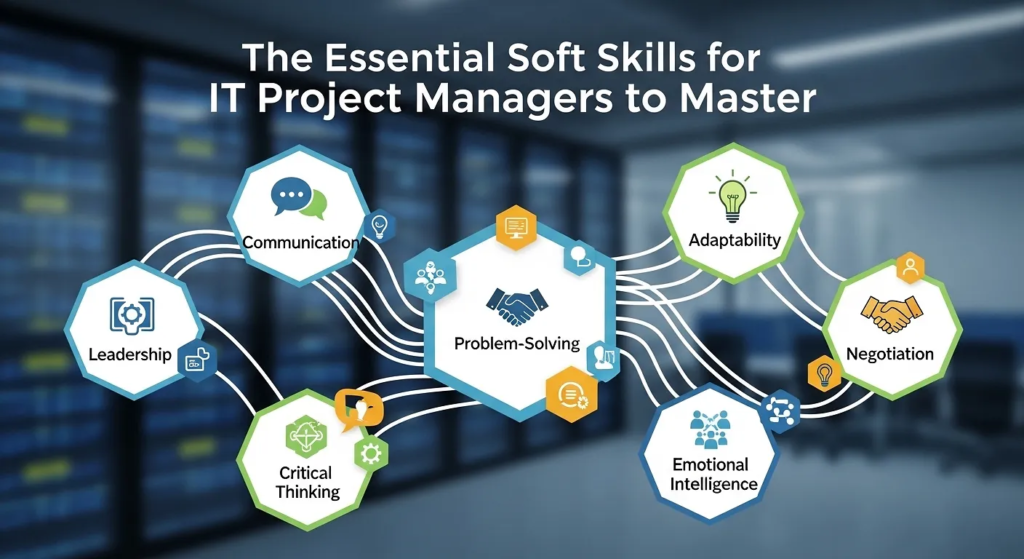
Essential soft skills for IT project managers
Discover the essential soft skills for IT project managers in 2026. Learn how digital empathy, remote communication, and conflict resolution will skyrocket your tech career!
1. Context-Rich Asynchronous Communication
“Good communication” is a cliché. In 2026, the specific skill is asynchronous context framing. Because your team is likely spread across multiple time zones, you cannot rely on tapping someone on the shoulder or calling an impromptu Zoom meeting to clarify a requirement.
What it looks like in practice:
When a stakeholder changes a feature requirement, a traditional PM might drop a quick Slack message saying, “Hey team, we need to change the API endpoint.”
An elite IT Project Manager provides context. They send a structured asynchronous update:
- The What: We are changing the API endpoint.
- The Why: The client’s security compliance requires a different authentication method.
- The Impact: This pushes the frontend team’s deliverable back by two days, but the backend team can start immediately.
- The Action: (Tagging specific developers) Please review the attached Loom video walkthrough before your morning sync.
Why it’s essential:
Mastering remote IT project management skills means eliminating ambiguity. When developers in Kenya start their workday while the US team is asleep, they need crystal-clear context to execute without being blocked for 12 hours waiting for a reply.
2. Digital Empathy and Burnout Recognition
In a traditional office, you could see if a lead developer was frustrated or exhausted. You could read their body language. In a remote-first tech environment, burnout hides behind green “Active” dots on Slack and perfectly formatted pull requests.
What it looks like in practice:
Digital empathy requires actively reading between the lines of digital communication. It means noticing when a typically talkative engineer starts giving one-word answers in the daily standup. It means recognizing when a team member is consistently pushing code at 2:00 AM their local time and stepping in to redistribute the workload.
Why it’s essential:
IT projects are high-stress. Deadlines are tight, and server outages don’t respect weekends. If you cannot empathize with your team and advocate for their mental bandwidth, your turnover rate will skyrocket. The best PMs know that protecting their team’s energy is just as critical as protecting the project budget.
3. Stakeholder Storytelling & Expectation Management
An IT Project Manager must be bilingual. You need to speak “Developer” and you need to speak “C-Suite Executive.” Often, these two groups have entirely different priorities. Developers want to build scalable, perfect, technical architecture. Stakeholders want the product launched by Q3 to appease investors.
What it looks like in practice:
When a project hits a technical snag, say, the legacy database won’t integrate with the new cloud infrastructure, you cannot simply tell the CEO, “Our Kubernetes clusters are failing due to legacy stateful sets.”
You must use stakeholder storytelling. “We’ve encountered a roadblock with the old database. If we force the integration now, we risk the system crashing during our Black Friday sale. We need an extra week to build a secure bridge, which ensures 100% uptime for our customers.”
Why it’s essential:
You are managing expectations by translating technical roadblocks into business risks. When stakeholders understand the business “why” behind a delay, they are far more likely to grant you the time and resources your tech team needs.
4. Conflict Resolution in Decentralized Teams
Where there are high stakes and passionate engineers, there will be conflict. In IT, this often manifests as “religious wars” over tech stacks (e.g., “We should build this in Rust, not Python!”) or friction between Quality Assurance (QA) and Development teams.
What it looks like in practice:
When a conflict arises remotely, it often escalates quickly via text-based channels where tone is easily misinterpreted. The essential soft skill here is knowing when to pull the cord and move the conversation from a heated Jira comment thread to a face-to-face video call.
A skilled PM acts as a neutral mediator. You don’t make the technical decision for them; you facilitate a structured debate. You ask guiding questions: “What is the long-term maintenance cost of choosing Rust over Python? How does this align with our Q2 delivery goals?”
Why it’s essential:
Unresolved conflict paralyzes development pipelines. Your ability to de-escalate tension and guide brilliant minds toward a unified consensus is one of the highest-value leadership skills for tech project managers.
5. AI-Augmented Critical Thinking
Wait, isn’t AI a technical skill? Yes, using the tools is technical. But interpreting the output requires deep, human critical thinking. In 2026, AI tools will feed you predictive analytics, telling you that your project has a 75% chance of missing its deadline based on current velocity.
What it looks like in practice:
A novice PM panics at the AI’s prediction and demands the team work overtime. An elite PM uses critical thinking to question the data. Why is the velocity down? Is it because the AI isn’t accounting for the fact that two senior developers were onboarding three juniors this week?
Why it’s essential:
You must possess the confidence to override algorithmic suggestions with human context. Your critical thinking prevents the team from becoming slaves to the metrics and ensures that common sense prevails in project planning.
6. Extreme Adaptability and the Agile Mindset
Technology moves at breakneck speed. You might spend three months planning an integration with a specific software provider, only to have a new AI model drop on a Tuesday that renders that provider obsolete.
What it looks like in practice:
Adaptability means possessing an “Agile Mindset” that goes far beyond the formal Agile Scrum framework. It is the psychological resilience to throw away a month’s worth of planning without letting frustration bleed into your team.
When the scope changes massively, the adaptable PM doesn’t complain. They immediately pivot: “Okay team, the market has shifted. Here is our new north star. Let’s break down how we adjust our current sprint to accommodate this.”
Why it’s essential:
If you are rigid, you will break. Stakeholders and developers alike look to the project manager to set the emotional tone. If you handle massive changes with calm adaptability, the team will follow suit.
7. Cross-Cultural Competence
With remote work dominating the IT landscape, your team is highly likely to be globally distributed. Managing a team with members in the USA, Eastern Europe, and Kenya requires a deep understanding of cross-cultural dynamics.
What it looks like in practice:
It’s understanding that direct, blunt feedback might be perfectly acceptable to an engineer in New York, but could be perceived as highly disrespectful by a developer in another region.
It’s being mindful of global holidays (knowing not to schedule major releases during Thanksgiving in the US or Jamhuri Day in Kenya). It’s managing the EAT (East Africa Time) overlap with PST (Pacific Standard Time) to ensure no one is forced to take meetings at 11:00 PM consistently.
Why it’s essential:
When team members feel culturally respected and their local realities are acknowledged, their psychological safety increases. High psychological safety directly correlates with higher code quality, more innovation, and lower turnover.
How to Showcase Soft Skills in an Interview
Understanding these skills is one thing; proving you have them is another. When preparing for IT project manager interview questions soft skills, you must use the STAR Method (Situation, Task, Action, Result) to demonstrate your expertise.
If an interviewer asks, “Tell me about a time your project was failing,” they do not care about the broken code. They care about your human response.
Your Answer Structure:
- Situation: Our main application crashed 48 hours before launch due to a cloud configuration error.
- Task: I needed to get the system online while managing a panicking executive team and an exhausted engineering squad.
- Action: I shielded the developers by stepping in as the sole point of contact for the C-suite, providing hourly asynchronous updates (Stakeholder Management). I ordered food for the remote developers and enforced a mandatory 4-hour sleep rotation so no one made fatigue-driven mistakes (Digital Empathy).
- Result: We launched 4 hours late but with zero data loss, and the developers praised the calm environment in the post-mortem.
If you are figuring out how to become an IT project manager with no experience, your resume should heavily highlight these non-technical achievements from your past roles. Did you mediate a conflict? Did you translate complex ideas for a client? That is project management.
Core Soft Skills for Tech PMs Summary
To succeed as an IT Project Manager in 2026, mastering human dynamics is more important than technical frameworks. The essential soft skills include:
- Asynchronous Communication: Providing crystal-clear context for global, remote teams without relying on meetings.
- Digital Empathy: Recognizing remote burnout and protecting developer bandwidth.
- Stakeholder Storytelling: Translating technical roadblocks into business outcomes for executives.
- Conflict Resolution: Mediating “religious tech wars” and de-escalating text-based friction.
- Critical Thinking: Knowing when to trust AI project predictions and when to apply human intuition.
- Cross-Cultural Competence: Managing diverse teams across different time zones and communication styles gracefully.
Frequently Asked Questions (FAQs)
Q: Can I be an IT Project Manager without knowing how to code?
A: Yes. While understanding the Software Development Life Cycle (SDLC) and cloud architectures is vital, you are not hired to write code. You are hired to clear roadblocks so the developers can code. Your soft skills, communication, organization, and empathy, are your primary tools.
Q: How do I improve my remote IT project management skills?
A: Start by mastering asynchronous tools like Loom, Slack, and Notion. Practice writing project briefs that leave zero room for ambiguity. Furthermore, explicitly ask your global team members for feedback on how your communication style translates across screens and cultures.
Q: Will AI replace IT Project Managers?
A: No. AI is rapidly replacing Project Administrators, the people who just move Jira tickets and generate reports. It will not replace Project Leaders, the people who negotiate with angry stakeholders, motivate burned-out developers, and navigate complex human conflicts.
Q: How do I transition into this role from a technical background (like software engineering)?
A: You must shift your mindset from “how to build the product” to “how to build the team that builds the product.” Volunteer to lead daily stand-ups, manage the communication with the QA team, or handle the stakeholder presentation at the end of your next sprint. Add these leadership wins to your resume.
Conclusion
The technology we use to build software will continue to evolve at a dizzying pace. Frameworks will rise and fall, and AI will automate the mundane. But the fundamental nature of building products with a team of diverse, brilliant, and complex human beings will never change.By mastering the essential soft skills for IT project managers, from digital empathy to cross-cultural communication, you position yourself not just as a manager of tasks, but as an irreplaceable leader of people. Focus on the human element, and your career in tech will be future-proofed for 2026 and beyond.