

Is your startup wasting budget on manual citation building?
Our latest guide breaks down how to scale Local SEO Strategies for Startups using Astro, dynamic JSON databases, and programmatic schema deployment. Move away from legacy approaches and build a dynamic local hub.
Table of Contents
The $50,000 Autopsy: How One Startup Lost 82% of Traffic to Manual Grunt Work
A Silicon Valley B2B marketplace startup handed $50,000 to a traditional agency to dominate municipal markets across North America. The agency spent four months manually building citations, filling out spreadsheets, and copy-pasting local directory profiles. Six months later, the organic search traffic of the startup collapsed by 82% because the manual data drifted, creating mass inconsistencies that flagged their listings as spam.
Implementing modern Local SEO Strategies for Startups requires engineering precision, not manual labor. Relying on humans to input ZIP codes and addresses creates massive technical bottlenecks. The modern search engine does not care about manual directory submissions anymore.
According to 2026 local search data, over 45% of localized business discoveries now occur directly within zero-click AI search agents and Google AI Overviews, making traditional manual citation building obsolete without programmatic schema integration. If your tech stack lacks the architecture to feed structured local data directly to search crawlers, you are invisible. Static directory entries are dead.
The Traditional Local SEO Trap
Legacy agencies still sell citation packages as the ultimate local growth engine. This outdated approach treats search engines like digital telephone books from the early 2000s.
Manual data entry inevitably introduces spelling variations, broken links, and outdated phone numbers. The resulting NAP (Name, Address, Phone) profile mismatch triggers algorithmic penalties. Search crawlers prioritize programmatic verification over old-school manual listings.
Why Manual Citation Building Just Died
Static citation building fails because it cannot scale alongside a growing startup. When a business shifts operations, updates hours, or adds new service lines, updating hundreds of directories manually is impossible.
Such manual updates destroy your engineering ROI. Legacy platforms charge recurring fees to keep your listings locked behind their proprietary paywalls. Once you stop paying, your local data reverts to junk status, tanking your local visibility.
The Programmatic Shift in 2026 Search
Search engines now extract localized data directly from your own programmatic web architecture. They bypass third-party business directories entirely.
LLMs and search bots fetch real-time data from clean, structured JSON-LD schemas and fast-loading web pages. To survive this shift, your engineering team must build dynamic, self-updating local nodes. Automating this system is the only way to scale local acquisitions.
Programmatic Local SEO Landing Pages: Building Scalable Location Architecture
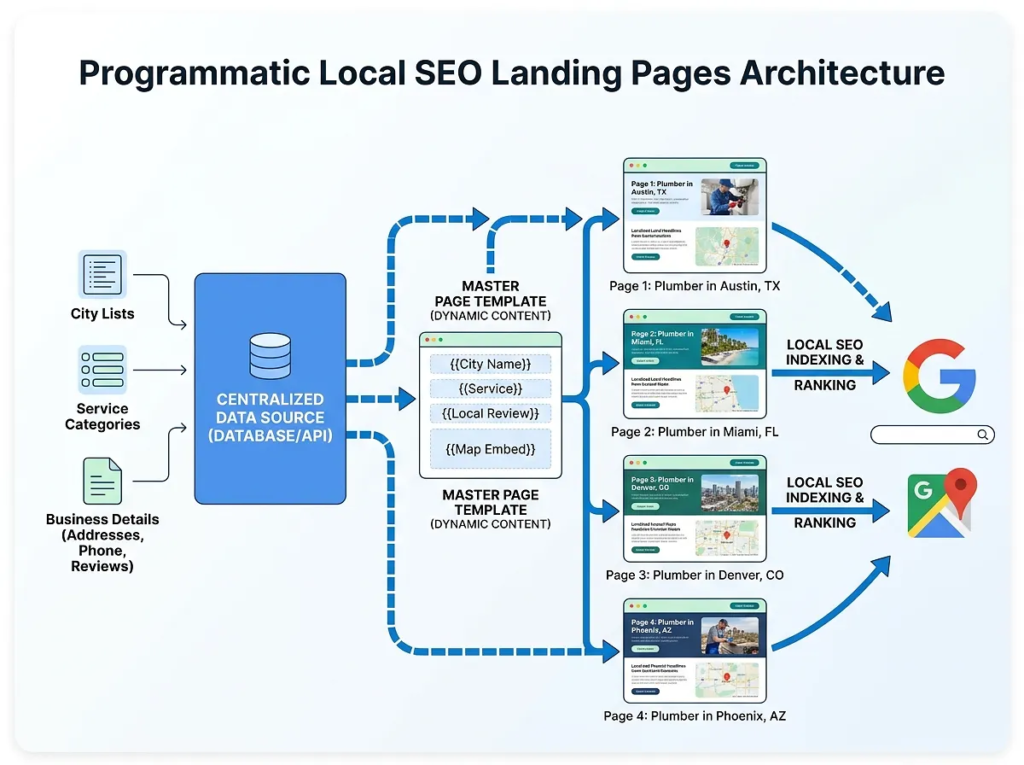
Building localized directories manually is a waste of developer resources. Programmatic local SEO landing pages leverage database-driven templates to generate thousands of highly optimized, lightning-fast location pages in seconds. This architecture guarantees fast page load speeds and complete search indexing.
[Location Database (JSON/Postgres)]
       │
       ▼
[Astro / Next.js Build Pipeline] ────► [Vercel / Netlify Edge]
       │                                     │
       ▼                                     ▼
[Dynamic Static Pages]                [Global CDN Delivery]
To deploy this scalable architecture, execute the following step-by-step setup guide.
Designing the Dynamic Location Schema Database
Create a centralized JSON database containing your location-specific variables. This file acts as the single source of truth for your build pipeline.
[
  {
    "city": "Nairobi",
    "slug": "nairobi-hub",
    "neighborhood": "Westlands",
    "postalCode": "00800",
    "phone": "+254-20-1234567",
    "latitude": "-1.2682",
    "longitude": "36.8054",
    "heroTitle": "Enterprise Tech Solutions in Nairobi",
    "localKeywords": ["Nairobi cloud migration", "Westlands tech consulting"]
  },
  {
    "city": "Austin",
    "slug": "austin-central",
    "neighborhood": "Downtown",
    "postalCode": "78701",
    "phone": "+1-512-555-0199",
    "latitude": "30.2672",
    "longitude": "-97.7431",
    "heroTitle": "Scalable DevOps Services in Austin",
    "localKeywords": ["Austin Kubernetes scale", "Downtown Austin software developers"]
  }
]
Save this file as locations.json in your source repository. Ensure every object contains geo-coordinates to fuel your automated schema configurations.
Automating Page Generation with Static Site Generators
Use a modern static site generator like Astro or Next.js to parse the location data and build statically generated assets. The following Astro code block demonstrates how to generate dynamic routes programmatically.
---
// src/pages/locations/[slug].astro
import locations from '../../data/locations.json';

export async function getStaticPaths() {
  return locations.map((loc) => ({
    params: { slug: loc.slug },
    props: { loc },
  }));
}

const { loc } = Astro.props;
---
<html lang="en">
<head>
  <title>{loc.heroTitle}</title>
  <meta name="description" content={`Find premier developer services in ${loc.city}, ${loc.neighborhood}. Contact our local team at ${loc.phone}.`} />
</head>
<body>
  <main>
    <h1>{loc.heroTitle}</h1>
    <p>Serving the tech ecosystem in {loc.neighborhood}, {loc.city} ({loc.postalCode}).</p>
    <ul>
      {loc.localKeywords.map((kw) => <li>{kw}</li>)}
    </ul>
  </main>
</body>
</html>
This dynamic layout prevents the creation of empty, low-value DOM elements. Crawlers can crawl, render, and parse these highly structured static files instantly.
Deploying Your Programmatic Stack via Git Pipelines
Connect your Git repository to an edge-hosting provider like Vercel or Netlify to automate your deployment cycle.
- Log into your hosting dashboard and click Add New Project.
- Select your connected Git repository containing the Astro code.
- In the Build Command settings, input
npm run buildand set the Output Directory todist. - Click the Environment Variables tab and define your production API keys.
- Click Deploy Now to trigger the initial programmatic compilation of your directory.
Any future additions to your locations.json file will automatically trigger your deployment pipeline, creating new localized pages instantly.
Why This Works: Eliminating Duplicate Content Penalties
Search engine algorithms penalize sites that copy-paste the exact same content across different city pages. By injecting highly specific localized data variables, regional testimonials, and geographic coordinates into your build template, every page remains distinct. Programmatic generation transforms identical template files into unique local resources that rank highly without trigger warnings.
Advanced Schema Automation and GBP API Integrations
Clean structured data feeds search bots directly without requiring them to parse messy HTML. To dominate localized search results, you must automate your schema generation and connect your internal database directly to the Google Business Profile (GBP) API.
[Internal CMS Updates] ──► [Google Business Profile API] ──► [Instant Search Update]
Injecting Local Schema Markup for Startups at Scale
Dynamic local schema markup for startups ensures that zero-click AI search engines read your company data correctly. Inject this nesting template directly into the <head> of your programmatic location pages.
<script type="application/ld+json">
{
  "@context": "https://schema.org",
  "@type": "ProfessionalService",
  "@id": "https://webgaro.com/locations/nairobi-hub",
  "name": "WebGaro Nairobi",
  "url": "https://webgaro.com/locations/nairobi-hub",
  "telephone": "+254-20-1234567",
  "priceRange": "$$$",
  "address": {
    "@type": "PostalAddress",
    "streetAddress": "Delta Corner Tower, Westlands",
    "addressLocality": "Nairobi",
    "postalCode": "00800",
    "addressCountry": "KE"
  },
  "geo": {
    "@type": "GeoCoordinates",
    "latitude": -1.2682,
    "longitude": 36.8054
  },
  "areaServed": {
    "@type": "AdministrativeArea",
    "name": "Nairobi County"
  },
  "parentOrganization": {
    "@type": "Organization",
    "name": "WebGaro Global",
    "url": "https://webgaro.com"
  }
}
</script>
This nesting structure clearly links your localized child location to your global parent organization. Search engines use this hierarchical link to pass domain authority down to your local nodes.
Bypassing the Dashboard with Google Business Profile API Automation
Do not waste hours editing working hours or business descriptions inside the slow Google Business Profile dashboard. Bypassing manual dashboards via Google Business Profile API automation keeps your data perfectly accurate across thousands of branches.
# python/update_gbp_hours.py
import googleapiclient.discovery
from google.oauth2.credentials import Credentials

def update_location_hours(location_id, credentials_path):
    creds = Credentials.from_authorized_user_file(credentials_path)
    service = googleapiclient.discovery.build('mybusinessbusinessinformation', 'v1', credentials=creds)

    # Update object payload
    body = {
        "regularHours": {
            "periods": [
                {"openDay": "MONDAY", "openTime": "08:00", "closeDay": "MONDAY", "closeTime": "18:00"},
                {"openDay": "TUESDAY", "openTime": "08:00", "closeDay": "TUESDAY", "closeTime": "18:00"},
                {"openDay": "WEDNESDAY", "openTime": "08:00", "closeDay": "WEDNESDAY", "closeTime": "18:00"},
                {"openDay": "THURSDAY", "openTime": "08:00", "closeDay": "THURSDAY", "closeTime": "18:00"},
                {"openDay": "FRIDAY", "openTime": "08:00", "closeDay": "FRIDAY", "closeTime": "18:00"}
            ]
        }
    }

    # Execute API patch request
    request = service.locations().patch(
        name=f"locations/{location_id}",
        updateMask="regularHours",
        body=body
    )
    response = request.execute()
    return response
To configure this script, log into your Google Cloud Console and select your project. Click Enable APIs and Services, search for the My Business Business Information API, and click Enable. Create your credentials under the OAuth Client ID settings to generate your local authentication file safely.
Optimizing for AI Local Search Agents
AI agents do not scroll past page-one Google search results. These systems extract concrete answers straight from API endpoints, structural DOM nodes, and clean schemas.
Optimizing for AI local search agents requires removing render-blocking JavaScript files that prevent quick crawling. Ensure your server-side rendering is flawlessly fast so AI scrapers can capture your location, pricing, and operating status in under 200 milliseconds.
Why This Works: Structured Data feeds LLMs Directly
AI engines rely on semantic context, not raw keyword density. By serving a highly structured JSON-LD payload, you remove parsing guesswork for the LLM. The AI agent can confidently cite your business because the relational database links are clean, machine-readable, and host-verified.
Stop Doing Manual Grunt Work: Audit and Automate Your Local Stack
Relying on manual labor to grow your local search footprint is a failing strategy. Every manual task your team performs introduces severe latency, high cost, and data degradation. Modern startups need automated tech stacks to win local markets.
Run a Free WebGaro Local Automation Audit
Do not let hidden errors sink your regional organic growth. Use the WebGaro Automated Local SEO Scanner to instantly map your technical infrastructure.
Navigate to WebGaro SEO Scanner, input your production domain, and click Run Audit to identify structural schema errors. Our system checks your JSON-LD integrity, measures page-load speed, and flags inconsistent local NAP data.
Power Your Automated Programmatic Pages with High-Performance Hosting
Slow rendering speeds will destroy the conversion rates of your programmatic pages. You must eliminate render-blocking database bottlenecks by deploying on premium, developer-optimized edge infrastructure.
We recommend deploying your static dynamic framework on Vercel or hosting your databases with specialized providers like Kinsta or WP Engine. High-performance hosting ensures your static HTML files are instantly served to regional users.
Partner with WebGaro to Scale Your Local Search Footprint
Building a custom programmatic search engine requires expert development skills. If your internal dev team is already fully booked with core product development, let WebGaro build your automated search pipelines.
Our team of veteran developers and technical search engineers builds custom programmatic landing page systems, API pipelines, and schema architectures. Reach out to WebGaro today to eliminate manual bottlenecks and scale your search presence.
Frequently Asked Questions About Local SEO Strategies for Startups
How do programmatic local SEO landing pages handle duplicate content?
Programmatic page architectures avoid duplicate content penalties by dynamically injecting hyper-localized content blocks into every page. The system populates each template with unique geo-coordinates, hyper-local service directories, local client testimonials, and distinct ZIP-code variables. This database-driven customization ensures that search engine crawlers view every page as a highly distinct, high-value regional asset.
Can startups automate Google Business Profile updates without getting suspended?
Startups can safely automate their updates by utilizing the official Google Business Profile API instead of relying on unstable browser automation scripts. The official API pipeline uses secure OAuth 2.0 protocols authorized by Google, preventing the account suspensions triggered by unauthorized scraping bots. Keep your automated updates focused on verified business data points like operating hours, business photos, and customer service reviews to ensure long-term profile safety.
Why is local schema markup for startups critical for AI search agents?
AI search agents rely on highly structured, machine-readable data to provide instant answers inside zero-click AI search results. Local schema markup for startups formats your business information into neat JSON-LD code blocks that LLMs can crawl and verify without executing heavy frontend JavaScript files. This clean structured data format allows AI engines to confidently reference your localized locations without parsing messy, unstructured HTML content.