When you are starting a new venture, the sheer volume of jargon can be overwhelming. You have domains, trademarks, LLCs, and social media handles. But one of the most common and expensive points of confusion for early-stage founders is understanding the business name vs brand name debate.
Many entrepreneurs mistakenly believe that the name they file on their tax documents must be the exact name they paint on their storefront or put on their website header. This misconception leads to rigid, uninspiring branding and massive legal headaches when trying to pivot or expand product lines later on.
In 2026, building a scalable company requires you to understand the distinct separation between your legal entity and your consumer-facing identity.
In this comprehensive guide, we are going to dissect the difference between your corporate legal name and your brand name. We will explain how the world’s largest companies use the “Umbrella Strategy,” decode what a DBA actually is, and show you exactly how to structure your business so you can launch multiple brands without forming a new LLC every time. Let’s clarify your identity.
Table of Contents
What is a Business Name? (The Legal Entity)
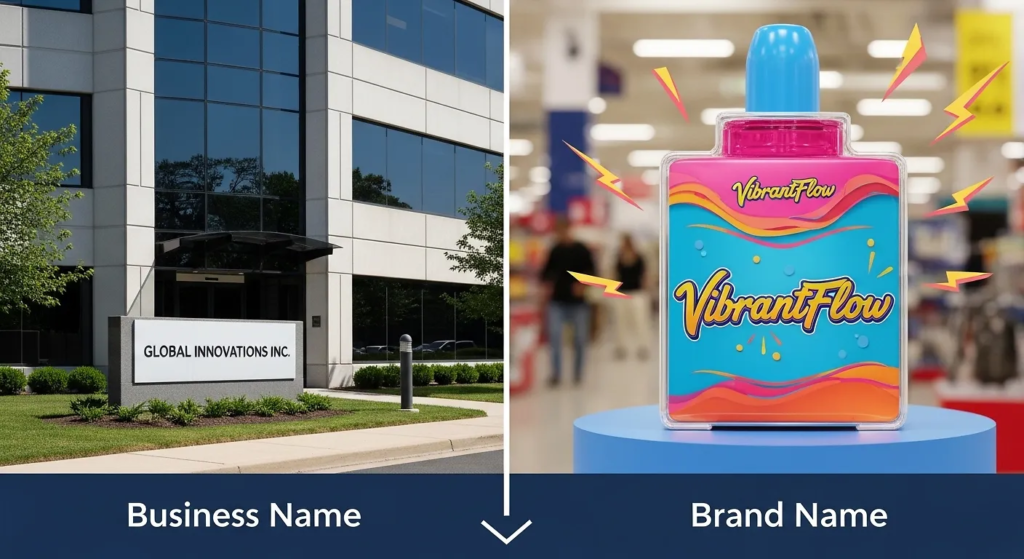
Your business name, often referred to as your “Legal Name” or “Corporate Name”, is the official, government-registered identity of your company.
Think of your business name like a person’s birth certificate. It is the name you use when dealing with the state, the IRS, and the legal system.
Characteristics of a Business Name:
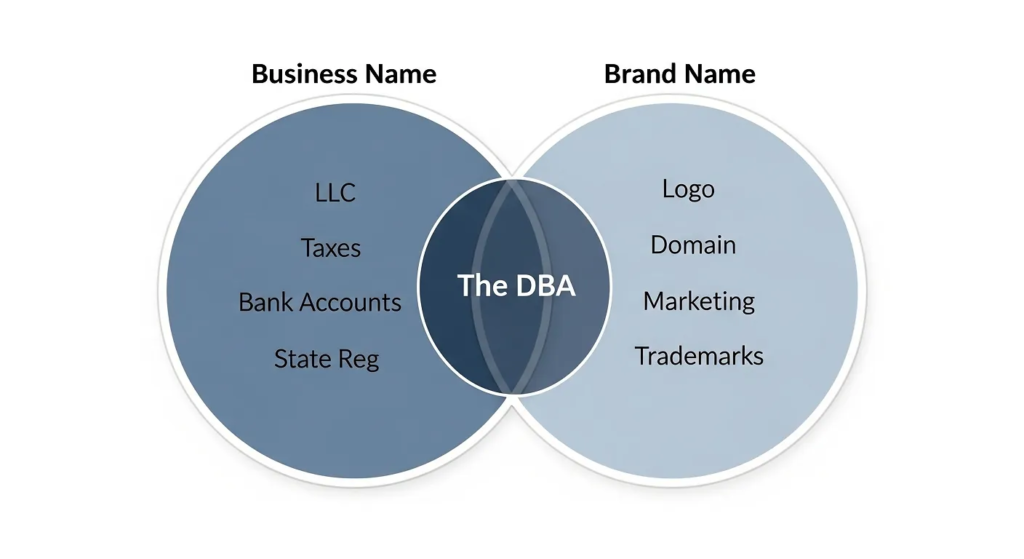
- Legal Suffixes: In the United States, your formal business name usually includes a legal designator at the end, such as “LLC” (Limited Liability Company), “Inc.” (Incorporated), or “Corp.” (Corporation). For example: Apex Global Logistics, LLC.
- Backend Operations: You use your business name to open corporate bank accounts, sign commercial leases, hire employees, and file your annual tax returns.
- Registration: It is registered at the state level (usually through the Secretary of State). Once registered, no other business in that specific state can register the exact same legal name.
What is a Brand Name? (The Consumer Identity)
Your brand name, often referred to as your “Trade Name”, is the consumer-facing identity of your company.
If the business name is the birth certificate, the brand name is the nickname everyone actually calls you. It is the creative, memorable, and emotional identifier that your customers interact with.
Characteristics of a Brand Name:
- No Legal Suffixes: You drop the boring legal jargon. Nobody says, “I am going to grab a coffee at Starbucks Corporation.” They just say, “Starbucks.”
- Frontend Operations: Your brand name dictates your logo, your .com domain name, your social media handles, and your product packaging.
- Emotional Connection: A brand name is designed to evoke trust, speed, luxury, or reliability. It is built for marketing, not for tax compliance.
The Core Differences: Business Name vs Brand Name
To truly master the business name vs brand name dynamic, let’s look at how they differ across three critical areas of entrepreneurship.
1. Legal Compliance vs. Marketing Strategy
Your business name exists to protect you legally. By forming an LLC, you create a corporate shield that separates your personal assets (your house, your savings) from your business liabilities. The state demands exact nomenclature for this shield to remain valid.
Your brand name exists to sell products. It is agile. It can be adapted, abbreviated, or stylized in lowercase letters to fit modern 2026 design aesthetics.
2. The Umbrella Strategy (One Business, Multiple Brands)
Here is an expert-level corporate structuring secret: One business name can own dozens of different brand names.
Look at the largest companies in the world.
- Alphabet Inc. is the legal business name. Google, YouTube, and Waymo are the brand names.
- Meta Platforms, Inc. is the legal business name. Facebook, Instagram, and WhatsApp are the brand names.
- Procter & Gamble Co. is the legal business name. Tide, Gillette, and Crest are the brand names.

You can apply this exact same strategy to your startup. You can register a generic legal name like Smith Holdings, LLC. Underneath that single LLC, you can operate a brand selling eco-friendly shoes, a completely separate brand selling digital marketing courses, and a third brand selling coffee beans. You run all the revenue through one bank account and file one tax return, saving you thousands of dollars in CPA and legal fees.
3. Naming Flexibility and Pivots
Startups pivot constantly. Imagine you register the legal name Miami iPhone Repair, LLC. Two years later, you decide to start repairing laptops, drones, and Androids, and you want to expand to Orlando.
If your brand name is tied strictly to your legal name, you have a massive marketing problem. However, if your legal name was Florida Tech Solutions, LLC, you could easily launch a new brand name like “ScreenFix” without ever having to file amendment paperwork with the state.
Can My Brand Name Be Different From My LLC? (The DBA Solution)
The most common question new founders ask is: “Can my brand name be different from my LLC?”
The answer is yes, absolutely. But you cannot just make up a name and start accepting checks under it. You must bridge the gap using a DBA.
Doing Business As (DBA) Meaning
DBA stands for “Doing Business As.” Depending on your state, it may also be called a Fictitious Business Name (FBN), an Assumed Name, or a Trade Name.
A DBA is a formal declaration you file with your county or state government that says, “Hey, my legal name is Smith Holdings LLC, but I will be operating publicly and accepting money under the brand name ‘BlueWave Surf Shop’.”
Why you need a DBA:
- Banking: If a customer writes a check to “BlueWave Surf Shop,” you cannot deposit it into the “Smith Holdings LLC” bank account unless the bank has a DBA on file proving that the two names belong to the same entity.
- Transparency: Consumer protection laws require the public to know who actually owns a business. A DBA provides a public record connecting the brand to the legal owner.
Understanding legal name vs DBA is simple: The legal name pays the taxes; the DBA cashes the checks.
Trademarking: Protecting Your Brand Identity
Here is a harsh reality that bankrupts many 2026 startups: Registering an LLC or a DBA does NOT give you the exclusive right to use that brand name.
When you register an LLC in Texas, the state simply ensures no one else in Texas can use that exact corporate name. It does nothing to stop someone in California from using your name, and it provides zero federal brand protection.
If you want to know how to trademark a brand name, you must understand the United States Patent and Trademark Office (USPTO).
- Trademarks Protect Brands, Not LLCs: You do not typically trademark a legal business name (e.g., Smith Holdings LLC). You trademark the consumer-facing brand name, the logo, and the tagline(e.g., BlueWave Surf Shop).
- The Federal Shield: A USPTO trademark grants you exclusive, nationwide rights to use that brand name in your specific industry class. If a competitor tries to use a confusingly similar name, you have the federal authority to send a Cease and Desist order and shut them down.
Before you spend $10,000 on branding, domains, and inventory, you must run a comprehensive trademark clearance search to ensure your chosen brand name isn’t already legally owned by someone else.
Which Name Goes on Your Google Business Profile?
The distinction between business and brand names creates massive confusion in Local SEO. When you set up your Google Business Profile (formerly Google My Business), which name do you use?
Google’s strict guidelines dictate that you must use your real-world, consumer-facing Brand Name.
Do not stuff your legal LLC name into your Google profile.
- Wrong: Smith Holdings LLC
- Wrong: BlueWave Surf Shop LLC – Miami’s Best Surfboards
- Right: BlueWave Surf Shop
If you include your legal LLC suffix on your storefront signage or Google Business Profile, it looks amateurish and clunky. Furthermore, adding promotional keywords to your brand name on Google is a direct violation of their terms of service and will result in your listing being suspended in 2026. Use your pure, clean brand name.
FAQ: Business Names, Brand Names, and DBAs
Q: Do I need a DBA if I operate under my own personal name?
A: If you are a Sole Proprietor and your legal name is John Doe, you can operate as “John Doe” without a DBA. But if you add anything to it, like “John Doe Consulting,” most states legally require you to file a DBA.
Q: Can I have multiple DBAs under one LLC?
A: Yes! This is the Umbrella Strategy in action. You can register an unlimited number of DBAs under a single LLC, allowing you to run a clothing brand, a software company, and a consulting agency all through one legal entity.
Q: Do I put my DBA or my LLC name on vendor contracts?
A: For legal protection, commercial contracts, leases, and terms of service should always use your legal LLC name. You can format it as: “Smith Holdings, LLC d/b/a BlueWave Surf Shop.” (d/b/a stands for doing business as).
Q: Does a DBA offer trademark protection?
A: No. A DBA is strictly for state-level transparency and banking. It offers zero intellectual property protection. Only a federal USPTO trademark protects your brand name.
Conclusion: Build the Shield, Then Paint the Banner
The debate between business name vs brand name doesn’t have to be complicated. Once you view them as two entirely different tools with two entirely different purposes, structuring your startup becomes effortless.
Your business name is your legal shield. Make it broad, make it professional, and use it to protect your assets and file your taxes.
Your brand name is your battle banner. Make it catchy, make it emotional, and file a DBA so you can market it aggressively to the world.
By separating your legal entity from your consumer identity, you future-proof your company. You give yourself the freedom to pivot, launch new product lines, and scale multiple brands under one roof. Stop stressing over the perfect corporate name, register your LLC, and get back to building a brand people love.
We Want to Hear From You
Did you set up your business using the “Umbrella Strategy,” or does your brand name match your LLC exactly? Have you ever run into banking issues because you forgot to file a DBA? Drop your experiences and questions in the comments below! If you are stuck on whether you need a DBA for your specific state, ask our community for guidance!