

Imagine spending two years building a wildly successful e-commerce brand. You have 50,000 Instagram followers, custom packaging, and a loyal customer base. Then, one Tuesday morning, you receive a formal “Cease and Desist” letter from a competitor.
They legally registered your exact business name last month, and now they are forcing you to hand over your domain, rebrand your entire company, and pay damages.
This nightmare happens to startups every single day. If you want to build a business that lasts, you must know how to trademark a brand name in 2026.
Registering a domain name or getting a Business Registration Certificate (BN2) from eCitizen does not give you exclusive rights to your name. Only a registered trademark provides the federal and legal shield necessary to stop copycats from stealing your hard-earned reputation.
In this exhaustive masterclass, we are going to demystify intellectual property. We will break down the exact KIPI trademark registration process in Kenya, reveal the hidden costs, explain how trademark classes work, and show ambitious founders how to lock down their brand globally. Let’s protect your empire.
Table of Contents
What is a Trademark?
Before filing paperwork, we must clear up the most common legal confusion among new founders: the difference between a trademark, a copyright, and a patent.
- Trademark: Protects brand identifiers. This includes your brand name, your logo, your slogan, and even unique brand colors or sounds. It ensures consumers don’t confuse your products with a competitor’s.
- Copyright: Protects original works of authorship. Think books, software code, website copy, music, and videos.
- Patent: Protects inventions and functional designs. Think of a new type of battery or a unique mechanical engine.
Step-by-Step: The KIPI Trademark Registration Process
In Kenya, trademarks are governed and issued by the Kenya Industrial Property Institute (KIPI). The process has been largely digitized, making it easier than ever for founders to file themselves.
Here is the exact, 5-step KIPI trademark registration process for 2026.
Step 1: The Preliminary Search (Form TM27)
Do not skip this step. Before you apply, you must ensure your chosen name isn’t already registered by someone else.
You will submit a Form TM27 to KIPI requesting a formal search of the registry. You must provide your proposed name or logo.
- Why it matters: If you blindly apply for a name that is already taken, your application will be rejected months later, and your application fees will not be refunded.
- Timeline: The search usually takes 3 to 7 working days.
Step 2: Choosing Your Trademark Classes Kenya
Trademarks are not universal. If you trademark the name “Zuri” for a shoe company, someone else can still legally trademark “Zuri” for a restaurant.
Trademarks are separated into 45 distinct categories based on the Nice Classification system (an international standard).
- Classes 1 to 34: Cover physical goods (e.g., Class 25 is Clothing and Footwear; Class 9 is Software and Electronics).
- Classes 35 to 45: Cover services (e.g., Class 35 is Advertising and Business Management; Class 43 is Food and Drink Services).
You must specify which class(es) your business operates in. Expert Tip: Only apply for the classes you actually sell in today. Applying for 10 different classes “just in case” multiplies your registration costs by 10.
Step 3: The Formal Application (Form TM2)
Once your search comes back clear, you submit Form TM2 (Application for Registration of a Trademark).
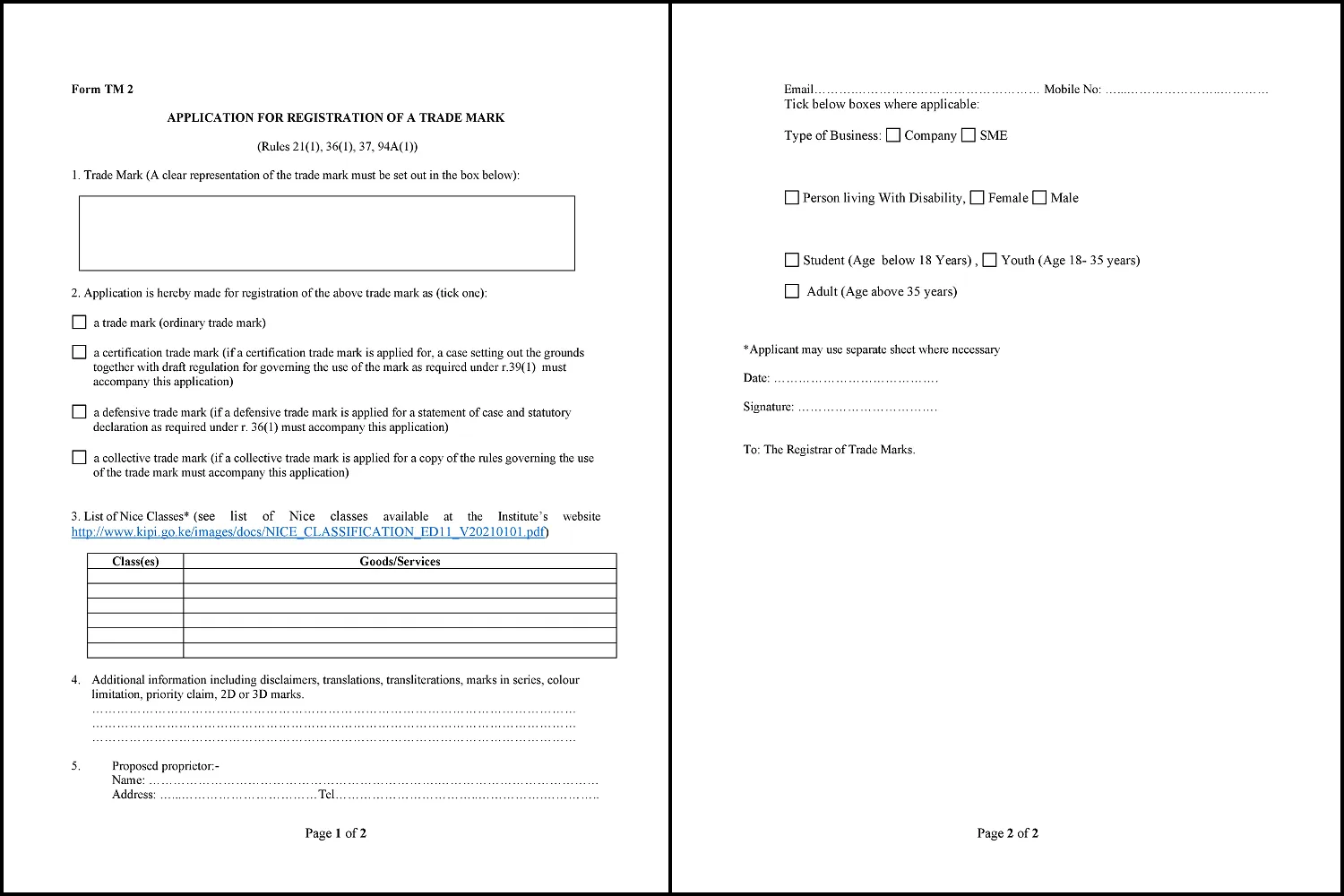
You will need to provide:
- Your name or your company’s Certificate of Incorporation.
- A clear representation of the logo or wordmark.
- The exact classes you are applying under.
- A physical address in Kenya.
Step 4: Examination and Advertisement (The 60-Day Window)
Once KIPI receives your application, an examiner will review it to ensure it doesn’t violate any trademark rules (e.g., it isn’t overly descriptive or offensive).
If it passes, KIPI will publish your trademark in the Industrial Property Journal.
Why? This gives the public 60 days to oppose your trademark. If a massive corporation thinks your new logo looks too much like theirs, they will file an opposition during this window. If no one opposes it after 60 days, you move to the final step.
Step 5: Issuance of the Certificate
Congratulations! You will pay the final registration fee, and KIPI will issue your official Trademark Registration Certificate. Your brand is now legally untouchable in Kenya for the next 10 years.
The Budget: Cost of Registering a Trademark in Kenya
Founders often assume trademarks cost hundreds of thousands of shillings. If you hire a top-tier corporate lawyer, it might. But if you handle the paperwork yourself or use a basic filing agent, the government fees are incredibly affordable.
Here is the exact breakdown of the cost of registering a trademark in Kenya (per class) in 2026:
- Preliminary Search (TM27): Ksh 3,000
- Application Fee (TM2): Ksh 4,000
- Advertisement Fee: Ksh 3,000
- Final Registration Fee: Ksh 2,000
Total Government Fees: Ksh 12,000 per class.
For the price of a mid-range smartphone, you can secure the intellectual property of your entire business. It is the highest-ROI investment you will ever make.
Going Global: International Trademark Registration (WIPO)
If you are a Kenyan tech startup building a SaaS product, or an e-commerce brand exporting to the USA, Europe, or the rest of Africa, a KIPI trademark is not enough. A KIPI trademark only protects you inside the borders of Kenya.
To protect your brand globally, you need to understand international trademark registration WIPO (World Intellectual Property Organization).
The Madrid Protocol
Kenya is a signatory to the Madrid Protocol. This is a massive advantage for local startups.
Instead of hiring expensive lawyers in the USA, the UK, and South Africa to file separate trademarks in each country, the Madrid Protocol allows you to file one single application (through KIPI) to WIPO.
- You select the specific member countries where you want protection.
- WIPO translates and distributes your application to the trademark offices of those specific countries.
- You pay one centralized fee (in Swiss Francs), which drastically reduces legal and translation costs.
Warning: You must have a registered “base” trademark in your home country (Kenya/KIPI) before you can use the Madrid System to expand globally.
Why Trademarks Get Rejected
The biggest heartbreak in the trademark process is waiting 6 months only to receive a rejection letter. To master how to trademark a brand name 2026, you must understand the “Spectrum of Distinctiveness.”
KIPI and WIPO will reject your name if it is too weak.
- Generic Names (Will be rejected): You cannot trademark “The Nairobi Coffee Shop” for a coffee shop. It is entirely generic. No one can own the exclusive rights to those words.
- Descriptive Names (Likely rejected): “Super Fast Delivery Express.” It just describes the service. It lacks unique branding.
- Suggestive Names (Strong): “Netflix” (Suggests movies on the internet, but is a unique portmanteau).
- Arbitrary Names (Very Strong): “Apple” for computers. The word exists, but it has absolutely nothing to do with electronics.
- Fanciful/Coined Names (Bulletproof): “Kodak” or “Rolex.” These are completely made-up words. They are the easiest names in the world to trademark because you invented them.
Learn more: 500 Catchy Business Name Ideas for Startups
Local SEO and Trademark Dominance
How does a legal trademark impact your digital marketing and SEO?
When you own the trademark to your brand name, you unlock Brand Bidding Protection on Google Ads.
Competitors often run Google Ads targeting your exact business name. When a customer searches for your startup, your competitor’s website shows up first.
If you do not own a trademark, there is nothing you can do about it. However, if you have a KIPI or WIPO trademark certificate, you can submit a formal complaint to Google. Google will actively restrict competitors from using your trademarked name in their ad copy, ensuring your Local SEO and organic search traffic remains yours.
FAQ: Trademarking Your Brand
Q: Can I trademark my logo and my business name together?
A: Yes. You can trademark a “Wordmark” (just the text of the name), a “Device Mark” (just the logo icon), or a combination of both. However, legal experts recommend trademarking the Wordmark first, as it offers the broadest protection regardless of how you change your font or colors in the future.
Q: How long does a trademark last in Kenya?
A: A Kenyan trademark lasts for 10 years from the date of registration. It can be renewed indefinitely for subsequent 10-year periods by paying a renewal fee.
Q: Do I need a lawyer to file a trademark?
A: It is not legally required. You can file as a “Pro Se” applicant (representing yourself) through KIPI. However, if your brand name is borderline descriptive, or if you expect massive corporate opposition, paying an IP lawyer Ksh 30,000 to Ksh 50,000 to handle the filing is highly recommended to avoid technical rejections.
Q: What is the difference between the ™ symbol and the ® symbol?
A: You can use the ™ (Trademark) symbol right now, for free. It simply tells the public, “I consider this my brand.” However, it carries very little legal weight. You can only use the ® (Registered) symbol after KIPI has officially handed you your final registration certificate. Using the ® symbol without a registered trademark is illegal in many jurisdictions.
Conclusion: Fortify Your Identity
Building a business takes relentless effort, sleepless nights, and immense capital. Leaving that business legally exposed is the greatest unforced error a founder can make.
Learning exactly how to trademark a brand name 2026 shifts you from a casual entrepreneur to a serious corporate player. By understanding the KIPI registration steps, defining your exact trademark classes, and utilizing the Madrid Protocol for global expansion, you build an impenetrable fortress around your intellectual property.
Do not wait until a competitor steals your identity. Run your preliminary search today, file your Form TM2, and secure the legal rights to the empire you are building.
We Want to Hear From You
Are you currently struggling to figure out which “Nice Classification” your startup belongs to? Drop your business model or what you sell in the comments below, and our community will help you figure out your exact trademark class! If you’ve successfully navigated KIPI, share your timeline with us!