If you are launching a company this year, you are entering the most saturated digital market in history. With the rise of generative AI, anyone can code a SaaS product in a weekend, generate a generic logo in ten seconds, and launch an ad campaign by Monday.
Because the barrier to entry for building a product has dropped to zero, the only remaining moat for your business is your brand.
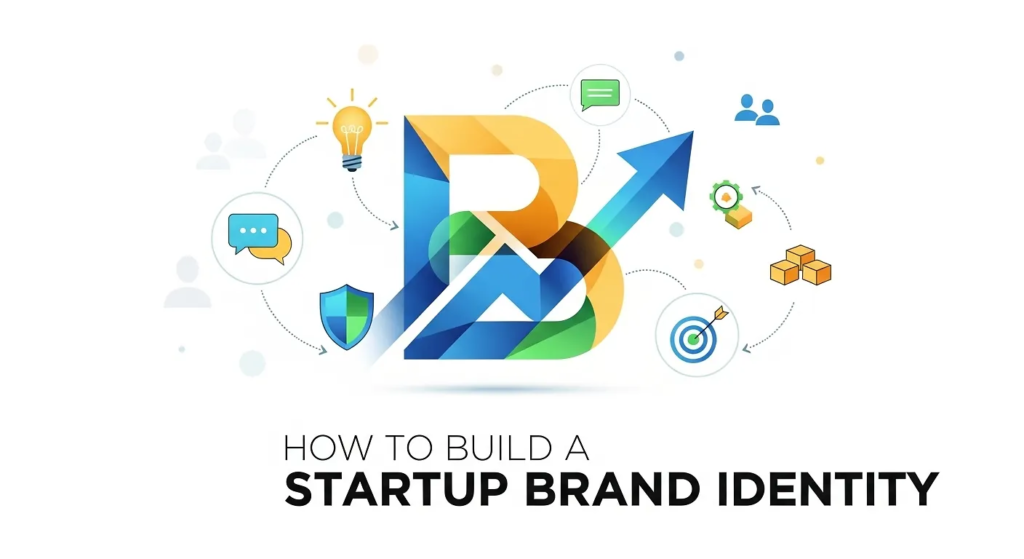
If you want to survive, you must learn exactly how to build a startup brand identity.
Many founders mistakenly believe that a brand is just a logo, a color palette, and a website template. That is a fatal error. A brand identity is the psychological, visual, and verbal anchor that dictates how the world feels about your company. It is the reason consumers will pay a 400% premium for an Apple laptop over a mathematically identical PC.
In this exhaustive, master-level guide, we are going to tear down the anatomy of a billion-dollar brand. We will explore the psychology of archetypes, teach you how to use a brand identity prism template, provide actionable brand voice and tone examples, and show you how to encode your startup visual identity guidelines. Let’s build an empire.
Table of Contents
Part 1: The Core Foundation
Before you even look at a color wheel or open Adobe Illustrator, you must define your brand’s DNA. If you skip this step, you will end up with a pretty website that says absolutely nothing.
The “Iceberg” Illusion of Branding
When consumers look at a brand like Nike, they see the “Swoosh.” But the Swoosh is just the tip of the iceberg (the 10% visible above the water). The 90% below the surface that actually sinks or sails the ship is the Brand Strategy.
To build that strategy, you must define three core pillars:
- Brand Purpose (The Why): Why does your startup exist beyond making money? If your B2B accounting software company was erased from the earth tomorrow, what would the world lose? Example: “We exist to give small business owners their weekends back.”
- Brand Vision (The Where): Where is your industry going in the next 10 years, and how is your startup leading the charge?
- Unique Value Proposition (The What & How): What exact pain point are you solving, and how are you doing it differently than the legacy competitors?
Defining Your Target Psychographics
In 2026, defining an audience as “Millennial males in the USA earning $75k+” is entirely useless. Demographics do not drive purchasing behavior; psychographics do.
You must define your audience by their anxieties, their desires, and their worldview.
- Demographic: Female, 25-35, lives in Austin, TX.
- Psychographic: Highly ambitious, values environmental sustainability, suffers from burnout, deeply distrusts traditional corporate marketing, and relies on micro-communities on Reddit for product recommendations.
When you know how your audience thinks, you know exactly how your brand must speak to them.
Part 2: The Psychology of Brand Archetypes
Humans are biologically wired for storytelling. Carl Jung, the famous Swiss psychiatrist, identified 12 universal “Archetypes”, fundamental character models that instantly trigger subconscious emotional responses in the human brain.
To build a resonant startup, you must align your brand with one primary archetype. This forces consistency in your marketing.
The 12 Jungian Archetypes (Which one are you?)
- The Outlaw (Rebel): You are here to disrupt and destroy the broken status quo. (e.g., Virgin, Harley-Davidson, early Uber).
- The Magician: You transform the customer’s reality, making complex problems disappear. (e.g., Disney, Tesla).
- The Hero: You inspire people to overcome their limits and achieve greatness. (e.g., Nike, Gatorade).
- The Lover: You focus on intimacy, aesthetics, and sensual pleasure. (e.g., Victoria’s Secret, Alfa Romeo).
- The Jester: You use humor and irreverence to break the tension of daily life. (e.g., Old Spice, Dollar Shave Club).
- The Everyman: You are relatable, unpretentious, and belong to the people. (e.g., IKEA, Target).
- The Caregiver: You protect and care for your customers above all else. (e.g., Johnson & Johnson, Volvo).
- The Ruler: You project absolute luxury, control, and exclusivity. (e.g., Rolex, Mercedes-Benz).
- The Creator: You provide tools for self-expression and innovation. (e.g., Lego, Adobe).
- The Innocent: You offer purity, simplicity, and optimism. (e.g., Dove, Coca-Cola).
- The Sage: You provide truth, wisdom, and data-driven intelligence. (e.g., Google, The New York Times).
- The Explorer: You offer freedom, adventure, and the discovery of the unknown. (e.g., Patagonia, Jeep).

Action Step: Choose one primary archetype and one secondary archetype. If your startup is a new FinTech app trying to disrupt big banks, you might be an Outlaw (Disrupting the system) mixed with a Magician (Making finance effortlessly easy).
Part 3: The Brand Identity Prism Template
Once your archetype is set, you need a framework to organize your traits. The most highly regarded tool among global brand strategists is Kapferer’s Prism.
Applying the brand identity prism template forces you to map out the six dimensions of your startup’s identity:
- Physique (External): The physical and visual traits of your brand. (e.g., Apple’s sleek, minimalist, silver and glass aesthetic).
- Personality (Internal): The human characteristics of your brand. (e.g., Wendy’s sarcastic, witty persona on X/Twitter).
- Culture (Internal): The core values and internal belief system driving your startup. (e.g., Patagonia’s fierce environmental activism).
- Relationship (External): How your brand interacts with customers. Are you their strict coach, their loyal servant, or their best friend?
- Reflection (External): The stereotypical perception of your target buyer. (e.g., A Whole Foods shopper is perceived as health-conscious and affluent).
- Self-Image (Internal): How your customer feels about themselves when using your product. (e.g., “When I drive a Tesla, I feel like a visionary saving the planet.”)
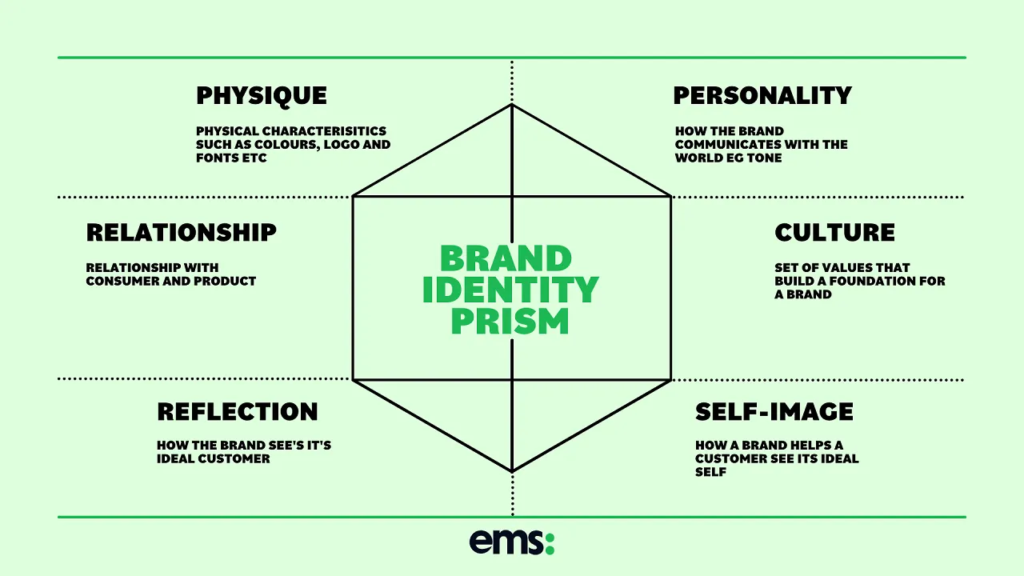
By filling out this prism template, you ensure that every designer, copywriter, and developer you hire understands exactly the psychological space your startup occupies.
Part 4: Establishing Startup Visual Identity Guidelines
We have mapped the psychology. Now, we must translate that psychology into pixels.
In 2026, the trend of “Blanding” (where every tech startup uses the exact same minimalist sans-serif font and flat blue colors) is dying. Consumers crave distinct, recognizable visual identities.
To maintain consistency, you must create an iron-clad PDF document: your startup visual identity guidelines. This document is the law. It governs the following four visual pillars.
Pillar 1: The Logo System
A single logo is no longer enough. Your brand must live on massive 4K desktop monitors, tiny Apple Watch screens, and social media profile circles. You need a responsive logo system.
- Primary Logo: The full logo, including the icon and the text (e.g., the Nike Swoosh + the word NIKE).
- Secondary/Stacked Logo: A vertically stacked version for narrow spaces.
- The Mark (Icon): The standalone symbol (e.g., just the Twitter Bird or the Apple).
- Clearance & Usage Rules: Your guidelines must explicitly state how much “breathing room” (padding) the logo requires, and strictly forbid stretching, skewing, or changing the logo’s colors.
Pillar 2: The Color Palette and “Dark Mode”
Color increases brand recognition by up to 80%. When you see “Tiffany Blue” or “Coca-Cola Red,” you instantly know the brand without reading a word.
Your guidelines must include:
- Primary Colors: The 1 or 2 dominant brand colors.
- Secondary/Accent Colors: The colors used for buttons, links, and highlights.
- Hex, RGB, and CMYK Codes: Exact color codes for digital and print formats.
- The 2026 Rule (Dark Mode Adaptability): Over 60% of users browse in Dark Mode. Your visual guidelines must dictate how your brand colors invert or adjust when displayed on black backgrounds. If your primary logo is dark navy, you must establish a strict white or neon alternative for Dark Mode UIs.
Pillar 3: Typography Hierarchy
Fonts have feelings. A heavy, jagged serif font communicates history and authority (like The New York Times). A rounded sans-serif font communicates friendly, modern tech (like Airbnb).
Your guidelines should establish a 2-font system:
- Display Font: A stylized font used exclusively for massive H1 Headers and advertising graphics.
- Body Font: A highly legible, web-safe font (like Inter, Roboto, or Open Sans) used for paragraphs and UI elements.
Pillar 4: Imagery and Photography Style
Does your startup use illustration, 3D renders, or real photography?
If photography, your guidelines must be specific. Example: “We never use posed corporate stock photos. All photography must feature diverse, real people in natural lighting, shot in a candid, documentary style, with a slightly warm color grade.”
Part 5: Finding Your Voice (Brand Voice and Tone Examples)
Visuals capture attention; words build trust. Your brand voice dictates the vocabulary, cadence, and attitude of your copywriting.
The Difference Between Voice and Tone
- Voice: Your brand’s consistent personality. It never changes. (e.g., You are always professional, or you are always witty).
- Tone: The mood your voice takes depending on the situation. (e.g., You might be witty on TikTok, but if a customer’s software crashes and they email support, your tone must shift to serious and empathetic).
How to Build a “This, But Not That” Matrix
To help your copywriters understand the boundaries of your startup’s voice, create a matrix:
- We are Authoritative, but not Arrogant.
- We are Funny, but not Offensive.
- We are Simple, but not Childish.
- We are Disruptive, but not Aggressive.
Real-World Brand Voice and Tone Examples
Let’s look at how voice radically alters messaging for three different startup personas saying the exact same thing (Announcing a new feature):
- The FinTech “Sage” (Trustworthy & Secure):
“We are pleased to introduce our latest cryptographic security update. Your assets are now protected by industry-leading encryption protocols. Log in to review the upgraded dashboard.”
- The Consumer App “Jester” (Witty & Relatable):
“We finally fixed that bug you’ve all been yelling at us about on Twitter. Update your app now to check out the new dashboard, it’s smoother than your morning coffee.”
- The Fitness “Hero” (Inspiring & Urgent):
“No more excuses. The new tracking dashboard is live. Update the app, set your new PR goals, and get back to work. Your future self is waiting.”
Part 6: UI/UX & Sonic Branding
In the modern digital landscape, your product is your marketing. How a user experiences your software interface is a core pillar of your brand identity.
Micro-Interactions as Brand Identity
If you are building a SaaS startup or a mobile app, brand identity lives in the micro-interactions.
- When a user clicks “Submit,” does the button simply turn grey, or does a satisfying, custom-branded checkmark animation burst onto the screen? (Think of Mailchimp’s famous high-five animation when you send an email campaign).
- These tiny moments of delight cement your brand’s archetype (The Magician, The Jester) into the user’s subconscious.
Sonic Branding (Audio Identity)
Visual real estate is shrinking. With the rise of voice search and screenless wearables, sonic branding is the next frontier.
A sonic brand is the specific sound associated with your company. Think of the Netflix “Ta-dum”, the McDonald’s “I’m lovin’ it” whistle, or the specific ding your iPhone makes when a payment succeeds.
Startups in 2026 must consider commissioning a custom “Audio Logo”, a 2-second sound bite that plays at the end of YouTube ads, podcasts, and successful in-app actions.
Part 7: The Pivot (Rebranding a Startup Company)
What happens if you launched your startup three years ago, DIY’d your logo on Canva, and now your branding looks incredibly amateur as you try to pitch Series A venture capitalists?
You need a pivot. But rebranding a startup company is fraught with danger. If done poorly, you alienate your existing user base and destroy your SEO rankings.
Signs You Need to Rebrand:
- Outgrown the Audience: You started selling to college students, but your product has evolved into an enterprise B2B tool. Your edgy, neon-pink branding is scaring away corporate CTOs.
- Trademark Nightmares: You received a Cease and Desist letter because your initial naming research was poor.
500 Catchy Business Name Ideas for Startups
- The “Sea of Sameness”: Your visual identity looks exactly like your three biggest competitors, making customer acquisition costs skyrocket.
How to Rebrand Without Losing SEO Equity
If your rebrand involves changing your startup’s name and .com domain, you must execute a flawless SEO migration strategy.
- The 301 Redirect Map: Every single URL on your old website must have a permanent 301 redirect pointing to the exact corresponding page on the new domain.
- Update Local Listings First: Before you announce the name change publicly, update your Google Business Profile, Yelp, and LinkedIn company pages to reflect the new brand name to prevent local search confusion.
- The Hybrid Phase: For the first 6 months, include a banner on your new website that says: “NewBrand (Formerly OldBrand).” This trains both Google’s entity-recognition algorithms and your human users to bridge the trust gap.
Part 8: Local SEO and Geo-Targeted Brand Identity
If your startup serves a specific geographic market in the USA (e.g., a prop-tech startup operating in Miami, or a food-delivery app in Chicago), your brand identity must integrate Local SEO trust signals.
Geo-Cultural Branding:
You cannot use the exact same brand voice in Texas that you use in New York. If your market is heavily localized, inject local vernacular, landmarks, and cultural nuances into your brand voice guidelines.
Google Business Profile (GBP) Branding:
Your GBP is often the very first brand touchpoint. Most startups neglect this.
Ensure that your profile picture is your high-resolution “Icon Mark” logo. Ensure your cover photo is a professionally designed graphic that strictly adheres to your visual identity guidelines.
Respond to local Google Reviews using your exact brand voice matrix. If your brand is the “Jester,” reply to 5-star reviews with witty, localized humor.
FAQ: Building a Startup Brand
Q: How much does it cost to build a brand identity in 2026?
A: It ranges wildly. A solo founder can use AI and templates for under $500 to get a basic MVP brand. Hiring a mid-level freelance brand strategist and designer typically costs $3,000 to $10,000. Hiring a top-tier USA branding agency to build out archetypes, voice, and comprehensive visual guidelines usually starts at $25,000 to $50,000+.
Q: How long does the branding process take?
A: A professional, comprehensive brand identity build (including strategy, visual guidelines, and voice matrices) takes an average of 6 to 12 weeks.
Q: Should my personal brand be the same as my startup’s brand?
A: No. While founder-led marketing is incredibly powerful in 2026, you and your company are separate entities. If you are a witty “Jester” on your personal LinkedIn, but your startup sells high-end cybersecurity software to banks (The Sage/Ruler archetype), merging those brands will destroy trust in the software. Keep them distinct.
Q: Does my logo need a hidden meaning?
A: No. The FedEx hidden arrow and the Amazon A-to-Z smile are brilliant, but they are the exception, not the rule. A logo does not need to be clever; it needs to be legible, scalable, and memorable.
Conclusion: Stop Blending In. Start Building.
Learning exactly how to build a startup brand identity is the most powerful leverage you have as a founder in 2026.
In a world drowning in artificial, automated content, human authenticity is the ultimate premium. By moving past the superficial “logo and colors” mindset, you can engineer a psychological fortress around your business.
Start with the foundation. Define your purpose, choose your Jungian archetype, and map out your traits using the brand identity prism template. Translate that psychology into strict visual identity guidelines, and empower your copywriters with a definitive voice and tone matrix.
A product solves a problem today. A brand builds a legacy forever. Stop treating your identity as an afterthought. Pull up a blank document, define your core truth, and build a brand the world cannot ignore.
We Want to Hear From You
Which of the 12 Jungian Archetypes do you think your startup belongs to? Are you the rebellious “Outlaw” or the trustworthy “Sage”? Drop your startup’s industry and your chosen archetype in the comments below! If you are struggling to figure out your brand voice, ask our community of strategists for some free feedback!