
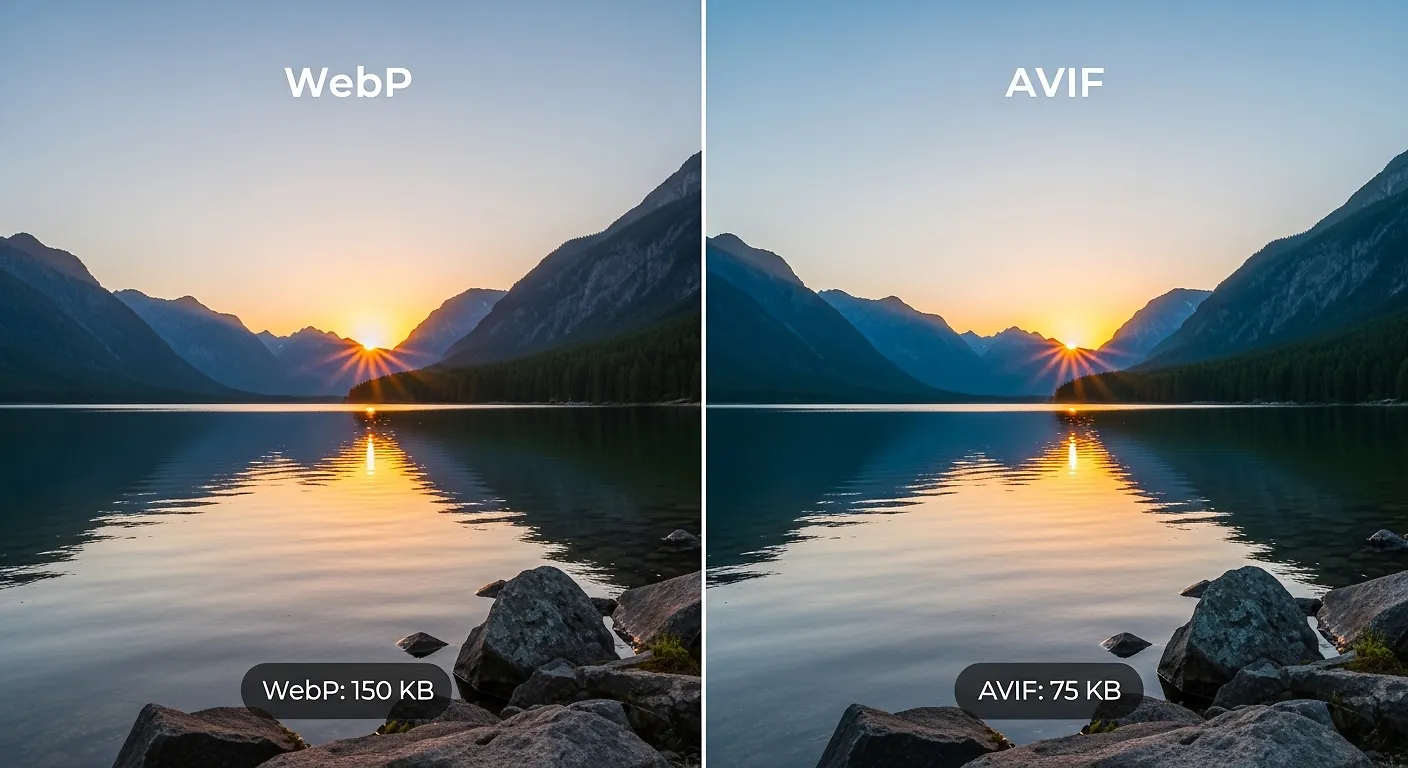
If you are serious about Core Web Vitals and page speed in 2026, you cannot afford to ignore your image delivery. High-resolution visuals dominate modern web design, but they are also the primary culprit behind sluggish load times.
When it comes to crushing file sizes without sacrificing quality, the WebP vs AVIF debate is front and center. But which one actually deserves your server space and SEO efforts this year?
In this comprehensive showdown, we are going to dive deep into the WebP vs AVIF battle. We’ll look past the basic compression claims, analyze real-world browser support, and uncover the hidden impacts on your technical SEO. Let’s settle this debate once and for all.
Table of Contents
The State of Image Optimization for SEO in 2026
Gone are the days when slapping a compressed JPEG on your homepage was “good enough” for Google. Today, Largest Contentful Paint (LCP) is a ruthless ranking factor. Search engines demand that visual content loads almost instantaneously, especially on mobile devices over 4G and 5G networks.
To dominate image optimization for SEO, you need next-generation image formats. These formats offer superior compression ratios, meaning your website loads faster, your bounce rates plummet, and search engine crawlers eat up your content with maximum efficiency.
What is WebP?
Developed by Google, WebP has been the gold standard for next-gen images for the better part of a decade.
- How it works: WebP uses predictive coding to compress images. It looks at neighboring pixels and predicts the values of others, encoding only the difference.
- The benefit: It provides both lossy and lossless compression, supporting transparency (alpha channel) and animation.
When comparing WebP vs JPEG size, WebP files are consistently 25% to 34% smaller than comparable JPEGs at equivalent quality levels. Today, WebP is universally supported and relatively easy to encode on the fly.
What is AVIF?
AVIF (AV1 Image File Format) is the new heavyweight champion of compression. Brought to life by the Alliance for Open Media (which includes tech giants like Netflix, Google, and Apple), AVIF is based on the AV1 video codec.
- How it works: It uses advanced algorithms designed for high-definition video to compress static images.
- The benefit: It offers unprecedented compression rates, high dynamic range (HDR), and wide color gamut.
AVIF can compress files up to 50% smaller than JPEGs, and roughly 20-30% smaller than WebP files, all while retaining stunning visual fidelity.
WebP vs AVIF: Head-to-Head Comparison
Let’s break down the WebP vs AVIF matchup across the metrics that actually matter for your website’s SEO and user experience.
1. File Size and Compression Rates
- Winner: AVIF
When it comes to pure weight, AVIF dominates. In extensive testing, AVIF consistently produces file sizes that are significantly lighter than WebP.
- JPEG to WebP: ~30% reduction.
- WebP to AVIF: ~20% to 30% further reduction.
Lighter files mean faster LCP times, directly translating to better SEO performance.
2. Image Quality and Artifacts
- Winner: AVIF
WebP is fantastic, but at very low bitrates (extreme compression), it suffers from “color banding” and loss of detail. AVIF, on the other hand, preserves fine details like text, sharp edges, and gradients beautifully, even at high compression levels. Furthermore, AVIF supports 10-bit and 12-bit color, whereas WebP is limited to 8-bit.
3. Browser Compatibility
- Winner: Tie (with a catch)
In the past, AVIF browser support was a major roadblock. As of 2026, that narrative has completely shifted. Chrome, Firefox, Safari, and Edge all fully support AVIF. WebP has 100% universal support across all legacy and modern browsers.
Pro Tip: You should always use HTML <picture> tags to serve AVIF, with a WebP fallback, and a JPEG absolute fallback for maximum safety.
4. Implementation and Server Load
- Winner: WebP
Here is what most competitors miss: Encoding time. AVIF takes significantly more server CPU power and time to compress than WebP. If you run a high-volume media site where users upload thousands of images daily, bulk-converting to AVIF can throttle your server. WebP encodes incredibly fast, making it much more resource-efficient for user-generated content (UGC) platforms.
Bulk Convert JPG & PNG to WebP
Looking to reduce image size instead?
Try our JPG & PNG to WebP Converter.

WordPress AVIF Support 2026
If you’re using WordPress, the good news is that WordPress AVIF support 2026 is fully integrated into the CMS core. You can upload AVIF files directly into your media library just like JPEGs.
However, to automatically convert existing JPEGs into AVIF and serve them dynamically, you will still want to leverage top-tier image optimization plugins like ShortPixel, Imagify, or enterprise CDNs like Cloudflare.
Expert Insight: Don’t just convert your old JPEGs to AVIF. Transcoding a lossy format (JPEG) to another lossy format (AVIF) can result in visual artifacts. Always try to generate AVIFs from your original, high-res PNG or RAW files.
Learn more: 20 Best CDNs for WordPress Sites to Boost Speed
Sustainability and Carbon Footprint
Beyond SEO, there is a hidden benefit to the WebP vs AVIF debate: Website Carbon Footprint.
The internet accounts for roughly 4% of global greenhouse gas emissions. Because AVIF files are smaller, they require less data transfer, which means less electricity is consumed by data centers, telecom networks, and end-user devices. By choosing AVIF, you aren’t just optimizing for Google; you’re building a greener, more sustainable web.
Local SEO & Image Delivery
If you run a local business, your image format matters just as much as your CDN. Local SEO relies heavily on mobile search (e.g., “contractors near me”). Mobile users are often on spotty 4G connections. Delivering AVIF images via an Edge CDN ensures that local users get lightning-fast load times, keeping them on your site and signaling to Google that your local page is high-quality.
FAQ: WebP and AVIF
No. In fact, AVIF preserves high-contrast edges and text better than WebP, even at smaller file sizes.
Absolutely not. The best practice is “Content Negotiation.” Configure your server or CDN to serve AVIF to compatible browsers, fallback to WebP, and finally fallback to JPEG.
Yes! AVIF supports animations (AVIFS) and is vastly superior to legacy GIFs and even animated WebPs in terms of file size.
Conclusion: Which Format Wins in 2026?
In the brutal WebP vs AVIF showdown, AVIF is the clear winner for performance and SEO in 2026.
Its unmatched compression rates and superior visual fidelity make it the ultimate tool for crushing your Core Web Vitals. However, WebP remains the ultimate safety net and is computationally cheaper to encode.
The Verdict: Serve AVIF as your primary format, keep WebP as your responsive fallback, and watch your organic rankings soar.
We Want to Hear From You
Have you made the switch to AVIF yet? Run a quick test on your homepage and drop your before-and-after LCP speeds in the comments below! If you ran into any weird server CPU issues during conversion, share your troubleshooting tips, our community would love to hear them!