In 2026, human attention spans are shorter than ever. Between zero-click Google searches, AI overviews, and rapid-fire short-form video, you have less than three seconds to tell a consumer exactly who you are and why they should care.
If your website header relies on a clunky, jargon-filled paragraph to explain your value, you are losing customers. You need a linguistic anchor. You need to know how to create a powerful brand tagline.
A brilliant tagline does not just describe what you sell; it captures the emotional transformation your customer will experience. It is the heartbeat of your entire marketing strategy. “Just Do It” doesn’t mention shoes. “Think Different” doesn’t mention computers. Yet, these phrases built multi-billion-dollar empires.
In this exhaustive masterclass, we are going to dissect the psychology of memorable branding. We will explore the critical slogan vs tagline difference, analyze iconic examples of catchy business taglines, and give you the exact brand messaging framework template used by top-tier Madison Avenue agencies. Let’s distill your brand into a masterpiece.
Table of Contents
The Great Confusion: Slogan vs Tagline Difference
Before you put pen to paper, you must understand exactly what you are trying to write. The internet often uses these two terms interchangeably, which leads to disastrous, disjointed marketing campaigns.
If you want to build a coherent brand, you must master the slogan vs tagline difference.
What is a Tagline? (The Permanent Anchor)
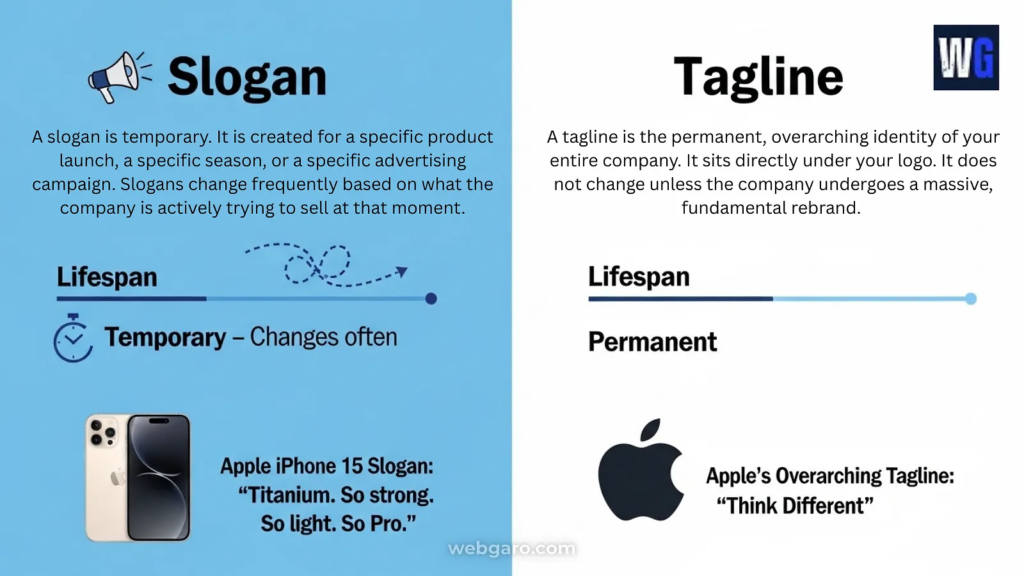
A tagline is the permanent, overarching identity of your entire company. It sits directly under your logo. It does not change unless the company undergoes a massive, fundamental rebrand. It represents your core DNA, your mission, and your brand promise.
- Example: Apple’s Tagline = “Think Different.”
- Example: L’Oréal’s Tagline = “Because You’re Worth It.”
What is a Slogan? (The Campaign Hook)
A slogan is temporary. It is created for a specific product launch, a specific season, or a specific advertising campaign. Slogans change frequently based on what the company is actively trying to sell at that moment.
- Example: When Apple launched the iPhone 15 Pro, their Slogan was = “Titanium. So strong. So light. So Pro.”
- Example: When Apple launched their privacy features, the Slogan was = “Privacy. That’s iPhone.”
The Rule of Thumb: You write a tagline for your company. You write a slogan for your product. Today, we are focusing strictly on the tagline, the permanent anchor.
The 4 Types of Brand Taglines
Not all taglines function the same way. Depending on your industry, your target audience, and your market positioning, you need to choose one of the four distinct tagline categories.
1. The Imperative Tagline (Commanding)
These taglines demand action. They usually start with a strong, active verb. They inspire the consumer to get off the couch and do something.
- Nike: “Just Do It.”
- YouTube: “Broadcast Yourself.”
2. The Descriptive Tagline (Clarity First)
If your startup is introducing a completely new, confusing concept to the market, you cannot afford to be overly abstract. You need a descriptive tagline that clearly states exactly what you do.
- TED: “Ideas Worth Spreading.”
- Walmart: “Save Money. Live Better.”
3. The Provocative Tagline (Thought-Provoking)
These are designed to make the consumer pause and rethink their current situation. They often use questions or counter-intuitive statements to disrupt normal thought patterns.
- Dairy Council: “Got Milk?”
- Dove: “Real Beauty.”
4. The Visionary Tagline (Abstract & Emotional)
These taglines focus entirely on the ultimate emotional destination of the consumer. They sell a feeling, a lifestyle, or an identity.
- Disney: “The Happiest Place on Earth.”
- DeBeers: “A Diamond is Forever.”
Deconstructing Genius: Examples of Catchy Business Taglines
To understand how to write your own, we must reverse-engineer the greats. Let’s look at three phenomenal examples of catchy business taglines and dissect the phonetic and psychological reasons they work.
1. M&M’s: “Melts in your mouth, not in your hands.”
- Why it works: It solves a specific consumer pain point. In the 1950s, chocolate melting in your pocket was a real problem. M&M’s used their tagline to highlight a unique physical feature (the hard candy shell) while communicating a clear benefit (clean hands).
2. MasterCard: “There are some things money can’t buy. For everything else, there’s MasterCard.”
- Why it works: It leverages contrast. It humbles the brand by admitting that family, love, and joy are more important than money, establishing deep emotional trust. Then, it sweeps in to claim absolute dominance over the financial aspect of your life.
3. Dollar Shave Club: “Shave Time. Shave Money.”
- Why it works: The pun. It uses rhythm, repetition, and a clever play on words to communicate two massive benefits (convenience and affordability) in just four words.
The AI Trap: Best Tagline Generators 2026
If you Google “how to write a tagline,” you will be bombarded with ads for AI tools. Search volume for the best tagline generators is massive because founders are desperate for a shortcut.
Here is the harsh reality: You should not use AI to write your tagline.
Generators like ChatGPT, Jasper, or Shopify’s Slogan Maker operate on predictive language models. They analyze millions of existing taglines and spit out the mathematical average.
The mathematical average is, by definition, mediocre.
If you ask an AI to write a tagline for a coffee shop, it will output: “Brewing happiness in every cup.” It is bland, soulless, and completely forgettable.
AI cannot understand the visceral human emotion of waking up exhausted at 5:00 AM and needing a jolt of espresso to survive a corporate presentation. AI cannot feel. Therefore, AI cannot write an emotional anchor for your brand. Use AI to brainstorm generic synonyms, but use human empathy to write the final tagline.
Step-by-Step: How to Create a Powerful Brand Tagline
Now that we understand the psychology, it is time to build yours. Follow this strict, 5-step framework to craft a tagline that resonates, converts, and endures.
Step 1: The “Brain Dump” (Finding Your Core Truth)
Open a blank document. Set a timer for 15 minutes. Write down everything your business does, why you started it, who you serve, and how you want them to feel.
Do not edit yourself. Write in raw, messy sentences.
Example for a B2B Accounting Software: “We make doing taxes less terrible. We save founders time so they can go home to their kids. We stop the IRS from fining small businesses.”
Step 2: The Feature-to-Benefit Translation
Consumers do not buy features; they buy a better version of themselves. Take your brain dump and translate every technical feature into an emotional benefit.
- Feature: Automated tax deductions.
- Benefit: More money in the bank.
- Emotional Transformation: Peace of mind and financial freedom.
Step 3: Trim the Fat (The 5-Word Rule)
A tagline must be brief to be memorable. Take your emotional transformation and aggressively cut words. Aim for 3 to 5 words maximum. Remove filler words like “the,” “and,” or “that.”
- Draft 1: We give founders peace of mind and financial freedom. (10 words – Too long)
- Draft 2: Financial freedom for busy founders. (5 words – Better)
- Draft 3: Own your finances. Own your time. (6 words – Punchy)
Step 4: The Rhythm and Phonetics Test
Read your shortlisted taglines out loud. Do they have a natural cadence?
Humans are biologically wired to remember rhythm and alliteration (words starting with the same letter). This is why “Bed, Bath & Beyond” sticks in your head.
If your tagline forces you to pause awkwardly or trip over syllables, go back to Step 3.
Step 5: The Trademark Clearance
Just like your business name, a tagline can be trademarked with the United States Patent and Trademark Office (USPTO). Before you print your new tagline on 1,000 t-shirts or put it on your homepage, search the USPTO TESS database to ensure a competitor hasn’t already claimed it.
The Ultimate Brand Messaging Framework Template
If you are still staring at a blank page, you need a rigid structure. Use this brand messaging framework template to force your brain into clarity. Fill in the blanks below to create your “Brand Positioning Statement,” which will then give birth to your tagline.
The Template:
“For [Target Audience] who are frustrated by [Customer Pain Point], our company provides [Core Solution] that delivers [Ultimate Emotional Benefit].”
Let’s fill it out for a fictional Meal Prep Delivery Startup:
"For [busy working parents] who are frustrated by [cooking unhealthy dinners after a 10-hour workday], our company provides [chef-cooked, organic meals delivered daily] that delivers [guilt-free family time and physical vitality]."
Now, extract the tagline from the “Ultimate Emotional Benefit” section:
- Tagline Idea 1 (Descriptive): Organic meals. Zero guilt.
- Tagline Idea 2 (Imperative): Reclaim your family time.
- Tagline Idea 3 (Visionary): Eat well. Live fully.
By forcing yourself to define the target audience and their pain point first, your tagline stops being a random clever phrase and becomes a hyper-targeted marketing weapon.
Brand Tagline Example for a Gift Shop
Because your business name is Garo Gift Shop, we have a massive strategic advantage, but also a specific trap to avoid.
The trap is redundancy. Since the words “Gift” and “Shop” are already in your legal brand name, your tagline must not use those words. If you say “Garo Gift Shop: The best custom gifts,” you are repeating yourself, and it fails the SCRATCH test for being “Tame/Boring.”

Since the name tells the customer what you are, the tagline must tell them why they should buy from you.
The Ultimate Tagline: “Make it personal.”
Here is exactly why Garo Gift Shop: Make it personal. is a million-dollar brand anchor:
1. It Passes the “Imperative” Psychology Test
“Make it personal” is a command (just like Nike’s Just Do It or Apple’s Think Different). It speaks directly to the buyer’s ego. It challenges them. It subtly whispers: “Don’t just buy them a generic mug or a basic watch from a supermarket in the CBD. Do better. Make it personal.” It drives sales because it makes the buyer want to be a more thoughtful partner, friend, or colleague.
2. It Passes the SMILE Test:
- S (Suggestive): It instantly suggests customization, engraving, and bespoke items without using the clunky word “customized.”
- M (Meaningful): Kenyans value deep relationships. A “personal” item carries profound emotional weight.
- I (Imagery): It makes the buyer picture their loved one’s name, face, or an inside joke printed on the item.
- L (Legs): It ages perfectly. Whether you are selling custom wooden frames today, or expand into personalized corporate leather bags or custom jewelry in 2030, “Make it personal” covers all future inventory.
- E (Emotional): It hits the heart. It elevates your products from simple commodities to emotional keepsakes.
3. It Passes the SCRATCH Test:
- It is incredibly easy to spell and pronounce (perfect for radio ads, TikTok voiceovers, or Instagram captions).
- It is exactly 3 words (the ultimate sweet spot for memory retention).
- It looks visually stunning and balanced when placed underneath the “Garo” logo.
It is short, it is punchy, and it forces the customer to realize that a generic gift simply isn’t good enough anymore.
The Power of the Geo-Modified Tagline
If you operate a local service business in the USA, such as a plumbing company in Dallas, a roofing contractor in Chicago, or a real estate agency in Miami, your tagline strategy should be drastically different from a global SaaS company.
You must leverage the Geo-Modified Tagline.
Local searchers prioritize proximity and trust. Including your city or state in your tagline sends a massive relevance signal to both Google’s Local algorithm and the human reading your website.
- Generic: “We fix your pipes fast.” (Forgettable).
- Geo-Modified: “Keeping Dallas Flowing Since 2012.” (Trustworthy, local, established).
- Generic: “Selling homes for top dollar.”
- Geo-Modified: “Unlocking Miami’s Best Real Estate.”
When you place a geo-modified tagline in your website’s H1 tag or Header graphic, you instantly lower your bounce rate. When a user clicks your link from Google, they immediately see their city name, confirming they are in the exact right place.
FAQ: Crafting Brand Taglines
Q: Does every business need a tagline?
A: Not necessarily. If your business name is highly descriptive (e.g., “Miami iPhone Screen Repair”), a tagline might be redundant. However, if you have an “Empty Vessel” abstract name (e.g., “Veloce”), a tagline is absolutely mandatory to tell the customer what you do.
Q: Can I change my tagline later?
A: Yes, but it is expensive. Changing a tagline requires updating your website, social banners, physical packaging, and advertising assets. Furthermore, it takes years to build brand recall in the consumer’s mind. Changing it too often destroys that equity. Treat your tagline as a 10-year commitment.
Q: What is the difference between a mission statement and a tagline?
A: A mission statement is an internal document guiding your employees and company culture (usually a full paragraph). A tagline is an external marketing asset designed for consumers (usually 3 to 5 words).
Q: How do I know if my tagline is good?
A: Use the “T-Shirt Test.” If you printed your tagline on a plain black t-shirt, would someone who does not work for your company proudly wear it in public? “Just Do It” passes the T-shirt test. “Synergistic B2B Solutions” fails miserably.
Conclusion: Condense Your Brilliance
Learning how to create a powerful brand tagline is an exercise in ruthless editing. It is the art of taking your life’s work, your massive vision, and your complex software, and condensing it into three unforgettable words.
Do not settle for the output of a random AI generator. Do not confuse a temporary campaign slogan for your permanent brand identity.
Take the time to execute the brain dump. Translate your technical features into emotional transformations. Use the brand messaging framework template to identify exactly who you are serving, and then craft a phonetic, rhythmic hook that sticks in their brain forever.
Your business is brilliant. It is time you wrote a tagline that proves it.
We Want to Hear From You
Are you struggling to write a tagline for your new startup? Don’t do it alone! Drop your company name and what you sell in the comments below, and our community of branding experts will reply with 3 free custom tagline ideas just for you! Let’s brainstorm together.